


Utility Bills Processing in Hong Kong: What AI OCR Can Deliver
Every medium and large organization in Hong Kong processes utility bills as part of its daily operations. While each individual bill may appear straightforward, the cumulative administrative effort can be substantial—particularly for organizations managing multiple offices, retail outlets, residential estates, hotels, hospitals, schools, or industrial facilities.
Property management companies may receive thousands of utility bills every month on behalf of building owners and tenants. Retail chains reconcile electricity and telecommunications invoices across hundreds of stores. Hospitality groups process utility expenses for multiple hotels, while finance departments in enterprises and government agencies manually verify invoices before they can be approved for payment.
The most common utility bills processed in Hong Kong include:
✔ CLP Power – Electricity bills for Kowloon, New Territories, and most commercial and industrial customers.
✔ HK Electric – Electricity bills for Hong Kong Island and Lamma Island.
✔ The Hong Kong and China Gas Company (Towngas) – Gas consumption invoices for residential and commercial properties.
✔ Water Supplies Department (WSD) – Water and sewage charge bills issued by the Hong Kong Government.
✔ Telecommunications providers such as HKT, HKBN, SmarTone, CSL, and China Mobile Hong Kong for fixed-line, mobile, broadband, and data services.
✔ Building management companies that issue management fee statements incorporating shared utility charges and maintenance costs.
Organizations often receive these documents in a variety of formats, including digitally generated PDFs, scanned paper invoices, email attachments, and even photographs captured on mobile devices. Bills may be written in English, Traditional Chinese, or bilingual formats, with each provider using its own document layout, terminology, tables, and billing structure.
Although utility bills follow similar business principles, every supplier presents information differently. Finance teams must still identify key fields, verify account numbers, validate billing periods, reconcile amounts against contracts or budgets, allocate expenses to the correct cost centres, and enter the information into ERP or accounting systems. When multiplied across thousands of invoices each month, these manual activities become time-consuming, expensive, and prone to human error.
Modern AI-powered OCR (Optical Character Recognition) has fundamentally changed this process. Rather than simply recognizing printed text, today's Intelligent Document Processing solutions understand the structure and meaning of utility bills, automatically classify documents, extract relevant business data, validate information against business rules, and seamlessly integrate with enterprise finance, procurement, and property management systems.
The result is an end-to-end automated workflow that significantly reduces manual effort while improving processing speed, accuracy, and compliance.
How elDoc – A Leading AI Document Processing Solution in APAC Processes Utility Bills
Utility bill processing is far more than extracting text from invoices. Organizations need a solution that can understand different document layouts, validate business information, integrate with enterprise systems, and automate the complete accounts payable workflow.
Built on years of experience delivering enterprise document processing solutions across Asia-Pacific, elDoc combines AI OCR, Intelligent Document Processing (IDP), Agentic AI, and workflow automation into a single secure platform capable of processing millions of business documents at enterprise scale.
1. Utility Bill Upload in elDoc
The first step in utility bill automation is securely capturing documents into the AI processing platform. elDoc offers flexible document ingestion methods to support organizations of all sizes—from departments processing a few hundred invoices to shared service centres and property management companies handling tens of thousands of utility bills every month.
Utility bills can be uploaded:
✔ Manually through the elDoc web interface for individual documents.
✔ In batches by uploading multiple utility bills simultaneously.
✔ Automatically via APIs, enabling seamless integration with existing enterprise applications.
✔ Through enterprise system integrations, including ERP, Finance, Procurement, Property Management Systems, Enterprise Content Management (ECM), and Document Management Systems (DMS) via API.
✔ From monitored email inboxes, Microsoft SharePoint, shared network folders, secure SFTP repositories, or high-volume production scanners via API.
For large enterprise deployments, fully automated integration is the preferred approach. During implementation, an implementation partner such as DMS Solutions works with each customer to design the optimal integration architecture based on existing business processes and IT infrastructure.
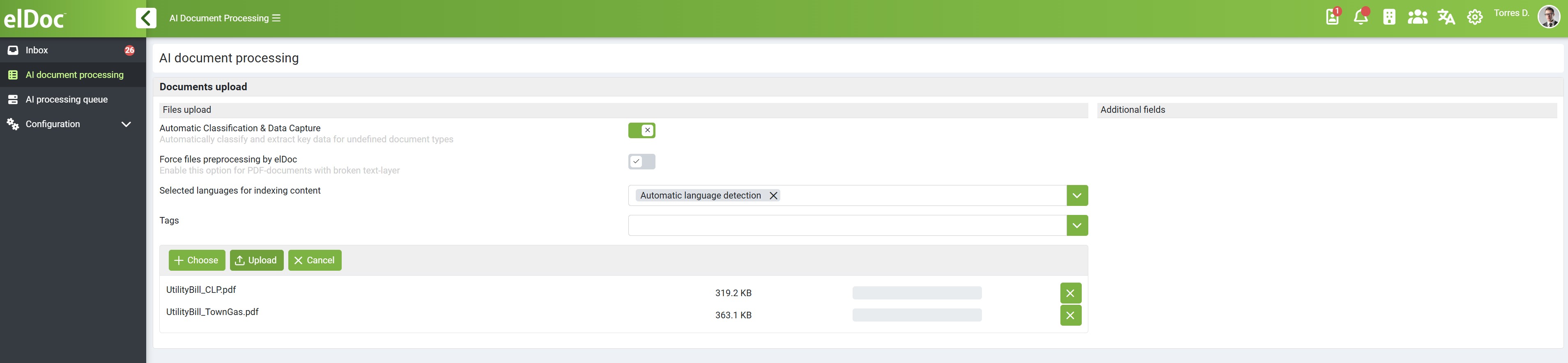
Documents are then automatically transferred into elDoc without manual intervention, ensuring a continuous and scalable document processing pipeline.
Whether utility bills are received individually or in large batches, elDoc automatically queues incoming documents and prepares them for high-speed AI processing, enabling organizations to efficiently handle everything from daily operational volumes to peak month-end processing loads.
2. AI Data Capture – No Templates Required
Once utility bills are uploaded, elDoc automatically identifies the document type and extracts the required business information using AI, without relying on predefined templates or manually configured extraction rules.
Unlike traditional OCR solutions that require a separate template for every supplier and document layout, elDoc uses AI-powered Intelligent Document Processing (IDP) to understand the structure and context of each utility bill.
This allows the platform to process documents from different providers—even when layouts, languages, or formats change—without ongoing template maintenance.
For utility bills issued by providers such as CLP Power, HK Electric, Towngas, the Water Supplies Department, and telecommunications companies, elDoc automatically recognizes and extracts key business information, including:
✔ Utility provider
✔ Customer and account number
✔ Service address
✔ Invoice number
✔ Billing period
✔ Invoice and due dates
✔ Meter number
✔ Previous and current meter readings
✔ Consumption and usage units
✔ Tariff and unit charges
✔ Taxes, levies, and additional fees
✔ Total amount payable
✔ Payment references
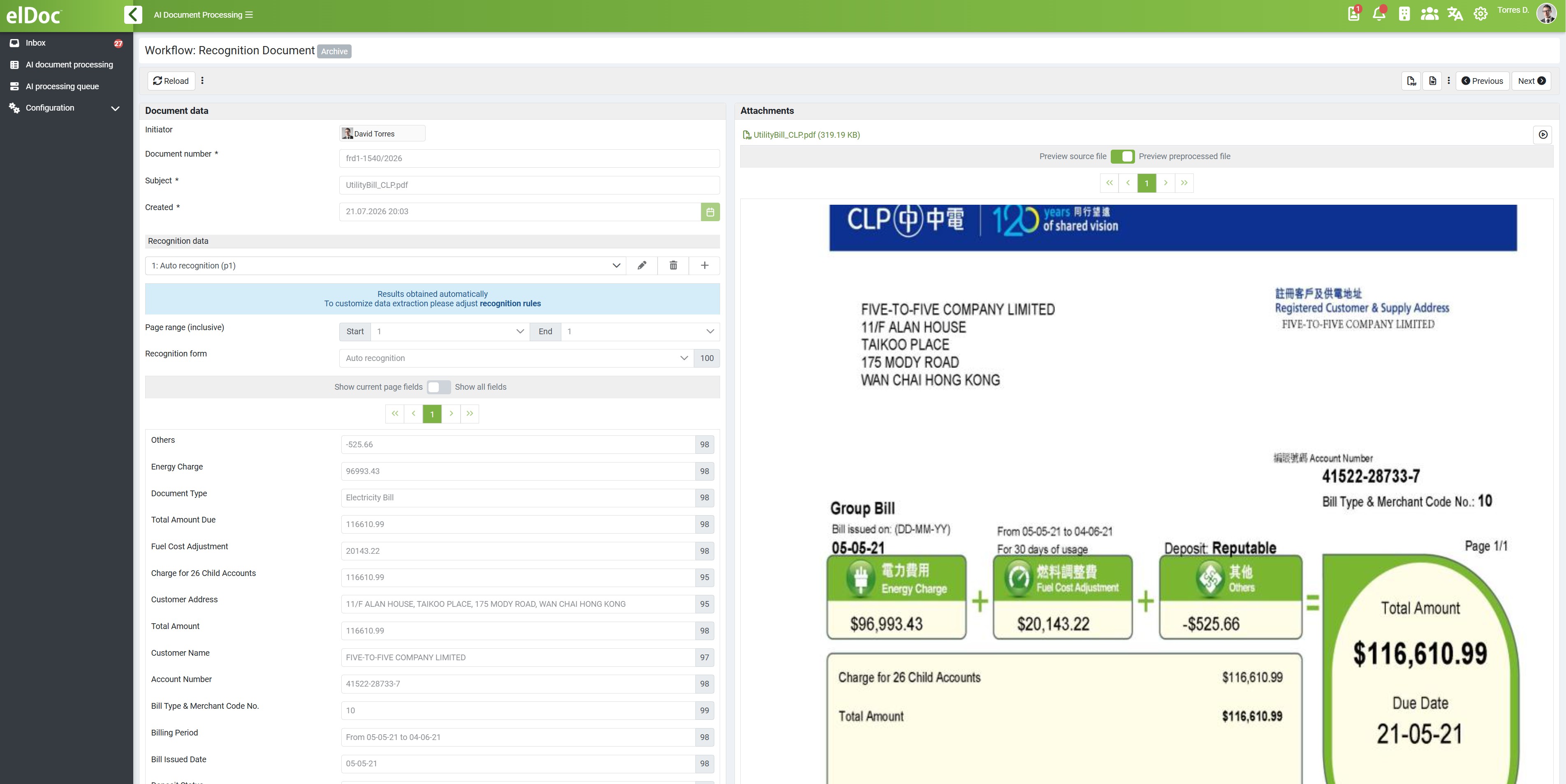
The platform processes PDFs, scanned documents, and mobile phone images, automatically enhancing image quality, correcting page orientation, and recognizing both English and Traditional Chinese content.
Using advanced AI and Large Language Models (LLMs), elDoc understands the semantic meaning of each field rather than simply reading text.
This enables highly accurate data extraction from diverse document layouts without requiring template creation, making the solution easier to deploy, simpler to maintain, and more resilient to changes in supplier invoice formats.
By eliminating template management, organizations can onboard new utility providers quickly and scale document processing without the ongoing effort traditionally associated with OCR-based solutions.
3. AI Data Validation and Business Rules
Following AI data extraction, elDoc automatically validates the captured information to ensure data quality before it is transferred to downstream business systems.
Confidence-Based Validation
Each extracted field is assigned an AI confidence score. Fields with confidence levels above the customer-defined threshold are automatically accepted, while only low-confidence or exceptional fields are presented to users for verification.
The intuitive validation interface allows users to quickly review and correct only the information that requires attention, providing:
✔ Side-by-side display of the original utility bill and extracted data
✔ Automatic highlighting of low-confidence fields
✔ One-click correction of extracted values
✔ Zoom, rotate, and image enhancement for scanned documents
✔ Complete audit trail of all modifications
This exception-based validation enables operators to process high document volumes while maintaining excellent accuracy and significantly reducing manual effort.
Configurable Business Rule Validation
Beyond AI confidence validation, elDoc supports customer-specific business rules that are configured during implementation to match each organization's operational and compliance requirements.
If any business rule fails, the document is automatically flagged and routed to the appropriate user or approval workflow.
By combining AI confidence validation with enterprise-specific business rules, elDoc ensures that only accurate and compliant utility bill data proceeds to the next stage of processing, minimizing downstream errors while supporting each organization's unique financial controls and approval policies.
AI Prompt Instructions – Teach AI Using Natural Language
Unlike traditional OCR platforms that require complex scripting, template modifications, or custom programming, elDoc allows organizations to guide AI using simple natural language instructions.
During implementation—or as business requirements evolve—administrators can provide AI with prompt-based instructions that explain how specific fields should be interpreted or extracted.
There is no need to develop new templates or write technical extraction rules.
For example, organizations can instruct elDoc to:
✔ Treat "Customer Reference" as the internal Account Number.
✔ Extract the Total Amount Due instead of the subtotal.
✔ Capture the billing address but exclude the correspondence address.
✔ Interpret supplier-specific terminology as standardized enterprise field names.
These instructions are written in plain natural language, making them easy for business analysts and process owners to maintain without specialist OCR expertise.
As new utility providers, invoice formats, or business requirements emerge, the AI can be refined simply by updating the prompt instructions rather than rebuilding extraction templates or retraining models.
This significantly reduces implementation effort and provides organizations with a flexible, future-proof document processing solution.
By combining AI-powered document understanding with natural language prompt engineering, elDoc enables organizations to continuously improve extraction quality and adapt to changing business needs—without the complexity traditionally associated with OCR configuration.
4. Data Export to CSV or JSON
Once utility bill data has been extracted and validated, elDoc converts it into structured, machine-readable formats for further processing.
The processed data can be exported as:
✔ CSV files for finance teams, reporting, reconciliation, and bulk import into accounting systems.
✔ JSON files for automated exchange with ERP, property management, billing, procurement, and other enterprise applications.
Organizations can define which fields should be included, how they should be named, and how the output should be structured.
For example, data from CLP Power, HK Electric, Towngas, and Water Supplies Department bills can be standardized into a common output format, regardless of the original document layout.
Typical exported fields may include:
✔ Utility provider
✔ Customer account number
✔ Service address
✔ Billing period
✔ Invoice date
✔ Due date
✔ Meter number
✔ Previous and current readings
✔ Consumption
✔ Total amount
✔ Currency
✔ Payment reference
✔ Validation status
For large-scale processing, elDoc can automatically transmit individual JSON records directly to connected systems.
This enables straight-through processing from document upload and AI data capture to validation, system integration, reporting, and payment preparation—with minimal manual intervention.
5. Assign a Dedicated LLM for Utility Bill Processing
One of elDoc's unique capabilities is its LLM-agnostic architecture, which allows organizations to assign the most appropriate Large Language Model (LLM) to each document processing workflow.
Rather than relying on a single AI model for every task, elDoc enables different document types to be processed by different LLMs based on business requirements, performance, cost, language support, or data residency policies.
For example, an organization may choose to:
✔ Use one LLM exclusively for utility bill processing.
✔ Process contracts with a different model optimized for legal documents.
✔ Assign another LLM for invoices and accounts payable.
✔ Select an on-premises or private LLM for sensitive or regulated information.
This intelligent model routing is configured within elDoc and is transparent to end users.
As documents enter the platform, elDoc automatically identifies the document type and orchestrates the appropriate AI model for processing.
Organizations can also change LLMs at any time without redesigning their document processing workflows.
As new AI models become available, they can be introduced for specific document categories while existing processes continue to operate uninterrupted.
This flexibility allows enterprises to balance accuracy, processing speed, operational cost, security, and compliance, ensuring that every document type—including utility bills—is processed using the AI model best suited for the task.
6. Enterprise Knowledge Management and Agentic RAG
The value of utility bill processing extends far beyond data extraction. Every processed utility bill represents valuable enterprise knowledge that can be securely stored, indexed, and made available for future reference.
Unlike standalone OCR solutions, elDoc combines Intelligent Document Processing with Enterprise Knowledge Management and Agentic RAG (Retrieval-Augmented Generation), transforming processed utility bills into a searchable corporate knowledge base.
Once a utility bill has been processed, elDoc automatically:
✔ Stores the original document in a secure enterprise repository.
✔ Preserves all extracted metadata and business information.
✔ Maintains complete processing and approval history.
✔ Creates a fully searchable document record.
✔ Maintains complete audit trails for compliance and regulatory purposes.
Ask Questions in Natural Language
Because every processed utility bill becomes part of the organization's enterprise knowledge base, authorized users can interact with the information using natural language instead of manually searching through folders or ERP systems.
For example, users can ask:
✔ Show all CLP Power invoices for Building A during the last 12 months.
✔ What was the total electricity expenditure for this property last year?
✔ Find all utility bills above HK$100,000 awaiting approval.
✔ Which utility providers supplied invoices for this project?
✔ Compare electricity consumption for this building with the same period last year.
✔ Show all Towngas invoices with unusually high consumption.
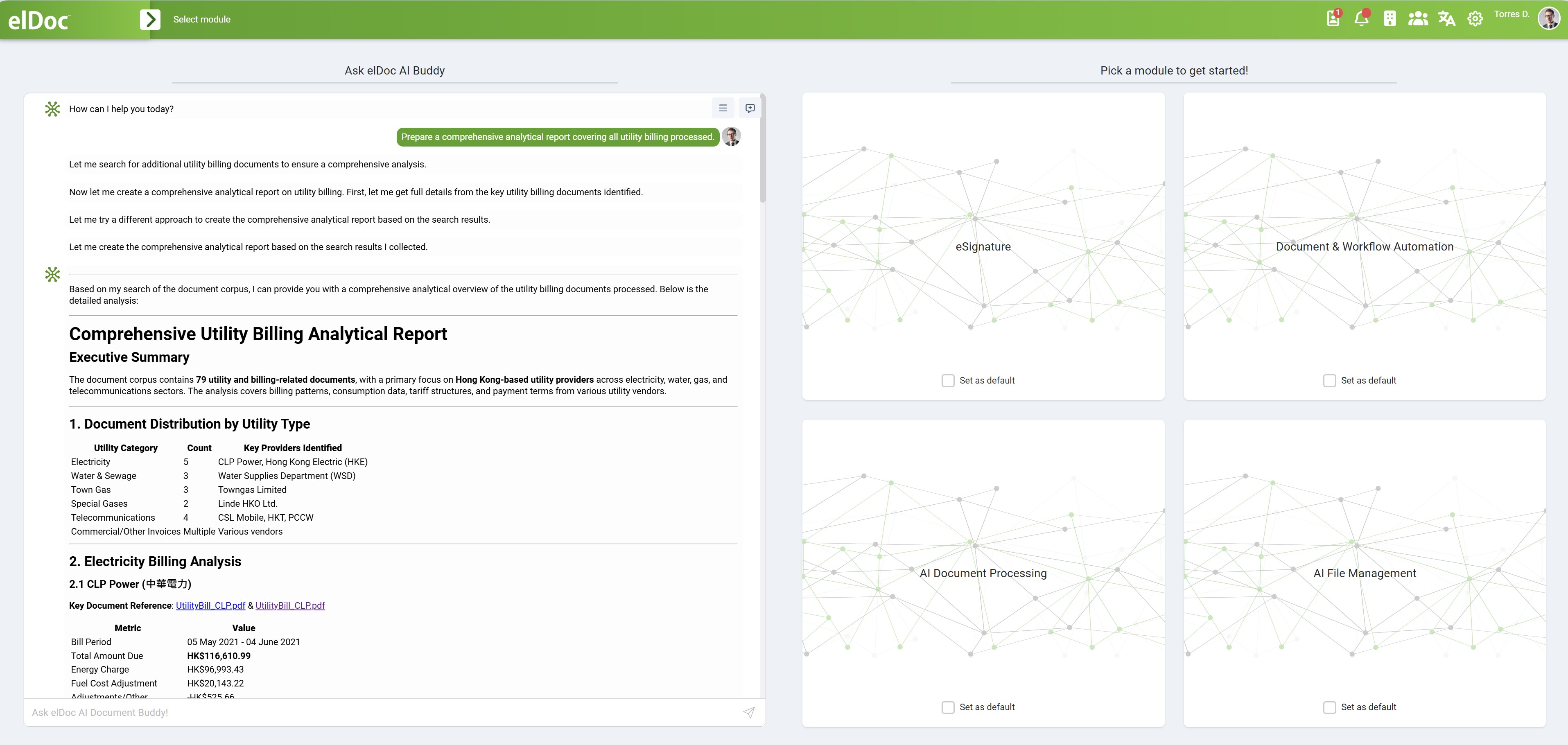
elDoc's Agentic RAG engine retrieves relevant utility bills, understands their content, and generates accurate, context-aware answers while respecting enterprise security permissions.
From Document Processing to Enterprise Intelligence
This transforms utility bills from static accounting documents into a valuable source of operational intelligence.
Finance teams, property managers, facility managers, procurement departments, and executives can instantly access historical records, analyze spending trends, investigate anomalies, support audits, and make informed business decisions—all through a simple conversational AI interface.
With every processed document, the enterprise knowledge base becomes richer, enabling elDoc to deliver increasing value long after the original invoice has been processed and paid.
Ready to Transform Utility Bill Processing?
Whether your organization processes hundreds or millions of utility bills each year, elDoc provides a secure, enterprise-grade platform that combines AI OCR, Intelligent Document Processing, Agentic RAG, Knowledge Management, and workflow automation into a single solution.
Discover how elDoc can automate your utility bill processing, reduce manual effort, improve accuracy, and seamlessly integrate with your existing enterprise systems.
Contact an authorized elDoc implementation partner in Hong Kong—DMS Solutions HK Limited—to schedule a demonstration, discuss your requirements, and explore how enterprise AI can transform your utility bill processing operations.