


Knowledge Intelligence Platform: From Enterprise Knowledge to Agentic AI
Enterprise AI is rapidly moving beyond simple chatbots and isolated document processing tools.
Organizations increasingly need a Knowledge Intelligence Platform capable of connecting enterprise documents, business data, permissions, AI models, retrieval pipelines, and specialized AI Agents within one controlled environment.
elDoc is a GenAI Platform for Document, Data and Knowledge Intelligence designed around this requirement.
At its core is the elDoc Agentic RAG Knowledge Base Pipeline, which transforms enterprise documents and unstructured data into an AI-accessible knowledge layer. Around this knowledge layer, elDoc provides 15 ready-to-use AI Agents for document and knowledge-intensive business tasks.
The result is not simply another enterprise chatbot. It is an architecture where knowledge retrieval, document intelligence, access control, AI Agents, and enterprise workflows operate together.
What Is a Knowledge Intelligence Platform?
Traditional knowledge management systems primarily help organizations store, organize, search, and retrieve information.
A Knowledge Intelligence Platform goes further.
It enables AI to understand enterprise information, retrieve the right knowledge in context, reason across multiple information sources, and use that knowledge to support business tasks.
This requires more than connecting an LLM to a folder of documents.
A production-ready enterprise architecture needs to address:
elDoc brings these capabilities together within one Knowledge Intelligence environment.
Agentic RAG Knowledge Base Pipeline
The foundation of Knowledge Intelligence in elDoc is its Agentic RAG Knowledge Base Pipeline.
Instead of requiring employees to manually search through folders, documents, contracts, reports, policies, correspondence, and other enterprise content, organizations can make authorized knowledge available through an intelligent retrieval layer.
The pipeline can be understood as:
Enterprise Documents & Data → AI Processing → Knowledge Indexing → Access-Aware Retrieval → Agentic RAG → LLM Reasoning → AI Agents → Business Output
When information enters elDoc, it can be processed, indexed, enriched, and prepared for semantic retrieval.
When a user or AI Agent subsequently submits a request, the system identifies relevant enterprise knowledge and supplies the appropriate context to the selected LLM.
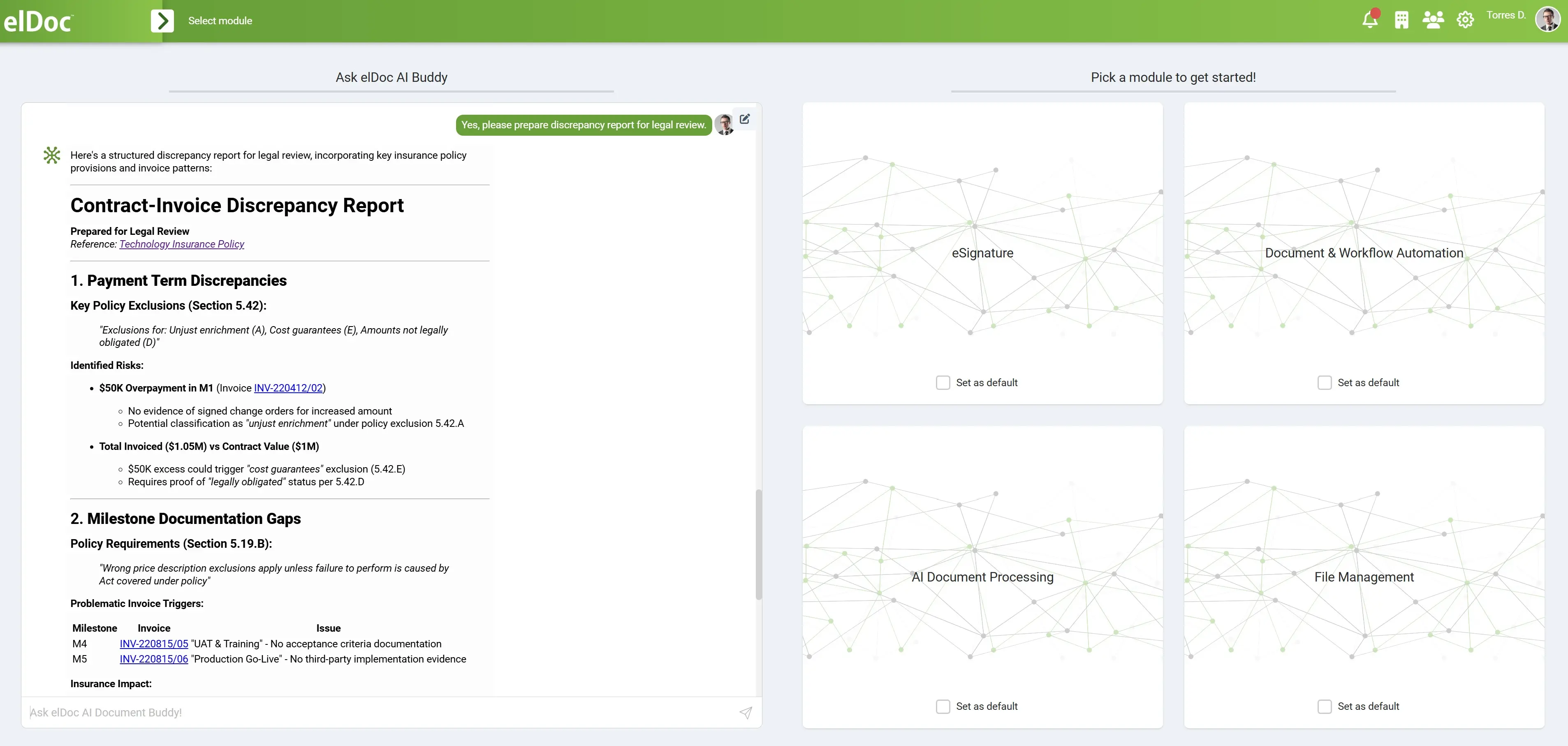
Agentic RAG extends this concept beyond basic question-and-answer retrieval. The system can use specialized agents and retrieval logic to determine what information is needed, where it should be retrieved from, and how it should be used to complete the task.
Access-Aware Knowledge: AI Should Only Retrieve What a User Is Allowed to See
Enterprise knowledge cannot become one unrestricted AI knowledge pool.
A finance employee, external contractor, legal team member, HR manager, department head, and administrator may all have different permissions.
This is why access-aware RAG is a critical part of the elDoc architecture.
The knowledge available to AI is connected to enterprise access controls. Retrieval therefore considers not only:
“Which information is relevant?”
but also:
“Which relevant information is this user authorized to access?”
This principle allows organizations to expand enterprise AI while maintaining control over sensitive documents and knowledge.
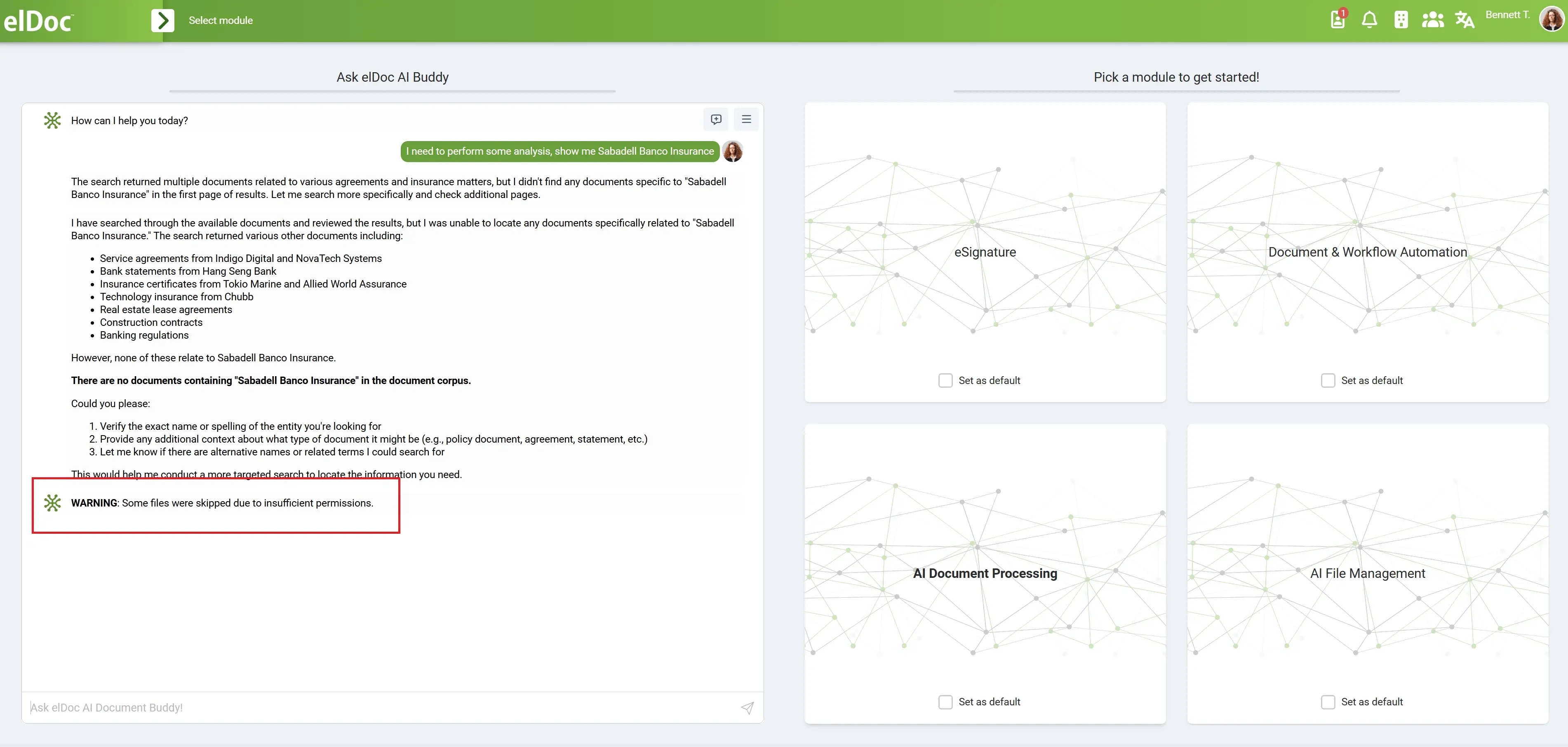
Permissions established across documents, folders, users, groups, roles, and organizational structures can remain part of the knowledge retrieval process.
For regulated organizations in particular, this provides an important distinction between deploying a general-purpose AI assistant and building a controlled enterprise Knowledge Intelligence environment.
LLM-Agnostic Architecture
Enterprise AI strategies are changing quickly.
The LLM selected today may not necessarily be the preferred model tomorrow. Different departments and use cases may also require different models based on performance, language capabilities, security requirements, cost, or deployment architecture.
For this reason, elDoc is built around an LLM-agnostic architecture.
Organizations are not required to structure their entire enterprise knowledge strategy around a single AI model.
Depending on the deployment and use case, enterprises can integrate different supported LLMs and AI infrastructure while keeping the document, knowledge, retrieval, security, and business process layers within the elDoc architecture.
This separation is particularly important for organizations pursuing Sovereign AI, private AI, or on-premises GenAI architectures.
The enterprise retains control over its knowledge architecture while the underlying AI models can evolve.
From Agentic RAG to 15 Ready-to-Use AI Agents
A Knowledge Intelligence Platform becomes significantly more valuable when enterprise knowledge can be used to perform actual work.
Alongside its Agentic RAG capabilities, elDoc includes 15 AI Agents within the platform.
These agents provide specialized capabilities for document-, data-, and knowledge-intensive tasks rather than requiring organizations to build every AI use case from scratch.
Depending on the process, AI Agents can work with documents and retrieved enterprise knowledge to support activities such as information extraction, document analysis, classification, comparison, summarization, knowledge retrieval, validation, and other business operations.
This creates two complementary layers:
Agentic RAG provides the knowledge. AI Agents use that knowledge to perform tasks.
The combination allows organizations to move from:
“Ask AI about our documents.”
to:
“Use our authorized enterprise knowledge to help execute the process.”
That transition is fundamental to enterprise Agentic AI.
One Knowledge Layer, Multiple AI Use Cases
A major advantage of building a centralized Knowledge Intelligence architecture is that the same controlled enterprise knowledge can support multiple applications.
An organization does not necessarily need to create a separate knowledge repository every time it introduces a new AI use case.
The same knowledge foundation can potentially support internal knowledge assistants, document processing, contract intelligence, policy analysis, case management, customer or citizen request processing, compliance operations, enterprise search, and specialized AI Agents.
This makes the knowledge layer a reusable enterprise AI asset rather than a feature attached to a single chatbot.
Flexible Deployment for Enterprise and Regulated Environments
Knowledge Intelligence architecture must also reflect where enterprise information is allowed to reside and where AI processing is permitted to take place.
elDoc supports flexible deployment approaches designed for different organizational requirements, including cloud, private cloud, and on-premises environments.
For organizations operating in highly regulated sectors, an on-premises or controlled private infrastructure can provide greater authority over critical components of the AI stack.
This can be particularly relevant for:
The objective is to enable organizations to adopt GenAI without giving up control over the enterprise knowledge that makes that AI valuable.
Transparent AI Consumption and Billing
The economics of enterprise GenAI can become difficult to understand when AI usage is spread across multiple tools, models, APIs, document-processing services, and individual applications.
A Knowledge Intelligence Platform should therefore provide not only technical control but also visibility into AI consumption and associated costs.
elDoc is designed around transparent usage and billing principles, helping organizations understand how AI capabilities are being consumed rather than treating AI expenditure as an unpredictable black box.
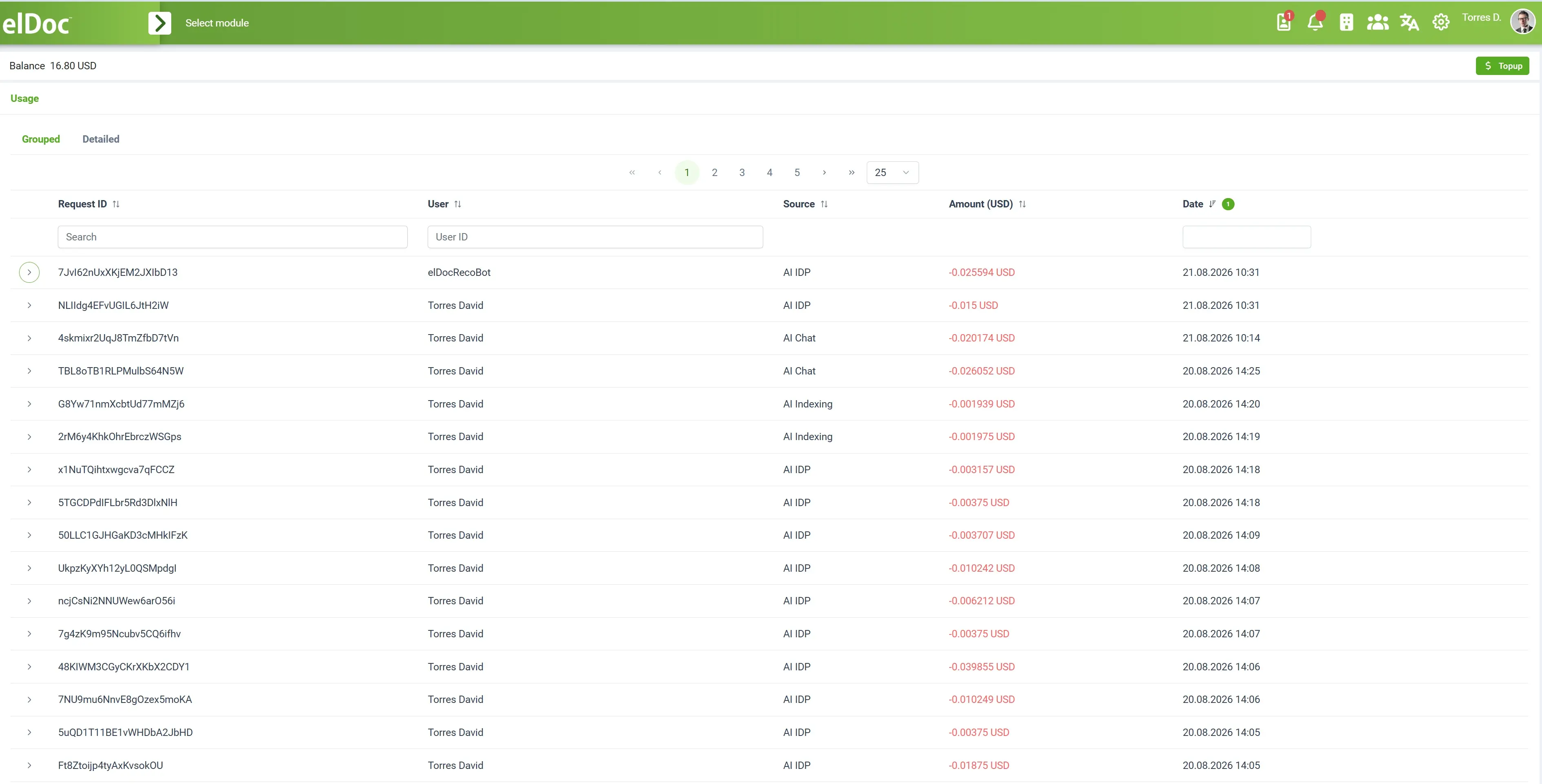
This becomes increasingly important as organizations move from small GenAI experiments toward production environments where potentially thousands or millions of documents and AI interactions may need to be processed.
AI scalability requires cost transparency alongside technical scalability.
From Document Management to Knowledge Intelligence
For years, enterprise information strategies focused primarily on storing documents securely and making them searchable.
Generative AI changes what organizations can do with that information.
Documents can become machine-understandable knowledge. Knowledge can become context for AI reasoning. Agentic RAG can dynamically retrieve that context. And specialized AI Agents can use it to support real business processes.
This creates a new enterprise architecture:
Document Management → Document Intelligence → Knowledge Intelligence → Agentic AI
elDoc brings these layers together within a single platform — combining enterprise document and data management, AI processing, Agentic RAG, access-aware knowledge retrieval, LLM-agnostic architecture, and ready-to-use AI Agents.
Build Your Enterprise Knowledge Intelligence Layer with elDoc
Enterprise AI becomes substantially more valuable when it can securely work with the knowledge an organization already owns.
With Agentic RAG, access-aware enterprise knowledge, 15 AI Agents, LLM-agnostic architecture, flexible deployment, and transparent AI consumption, elDoc provides a foundation for organizations moving from fragmented GenAI experiments toward controlled enterprise Knowledge Intelligence.
Talk to DMS Solutions (Hong Kong) Limited, an authorized elDoc implementation partner in Hong Kong and APAC, to explore how your existing documents and enterprise data can be transformed into a secure, AI-ready knowledge layer for Agentic RAG and AI Agents.