


AI Agents for Document Operations: What Hong Kong and APAC Businesses Actually Need
AI agents are rapidly becoming part of the enterprise technology landscape across Hong Kong and the wider APAC region. But when organizations start evaluating AI agents for document operations, an important architectural question is often overlooked:
How does an AI agent securely access the documents, enterprise knowledge, and business context it needs to perform its work?
An AI agent cannot effectively classify a document, validate information, compare contracts, update metadata, identify compliance risks, or create a new document unless it can first access and understand the relevant enterprise knowledge.
This is why enterprise AI agents cannot exist as isolated assistants built around a single Large Language Model.
They need a controlled knowledge layer, Agentic RAG, document intelligence capabilities, access permissions, and the ability to execute document operations within enterprise processes.
This is the architecture behind elDoc Document Intelligence Platform.
From day one, elDoc provides 15 ready-to-use AI Document Agents, combined with Agentic RAG and an LLM-agnostic architecture designed for enterprise document and knowledge operations.
Before an AI Agent Can Act, It Needs Access to Enterprise Knowledge
Consider a relatively simple task:
"Review this contract against our internal policies, identify inconsistencies, and prepare a summary of the risks."
The AI agent needs much more than access to the contract.
It may need access to corporate policies, previous contracts, internal guidelines, compliance requirements, supporting documentation, customer records, or other knowledge stored across the organization.
The same applies to document classification, validation, data extraction, document generation, compliance analysis, metadata population, and reporting.
This creates a fundamental relationship:
Enterprise Knowledge → Agentic RAG → AI Agent → Document Operation
Agentic RAG provides the knowledge foundation that allows an AI agent to retrieve relevant enterprise information and use it as context when performing a task.
Within elDoc, Agentic RAG is therefore not an additional chatbot feature. It is part of the Document Intelligence architecture that connects enterprise knowledge with AI-driven document operations.
Access-Aware Agentic RAG Matters
Connecting an LLM to a folder containing thousands of corporate documents is not an enterprise knowledge architecture.
Organizations need control over which documents an AI agent can access and what operations it is permitted to perform.
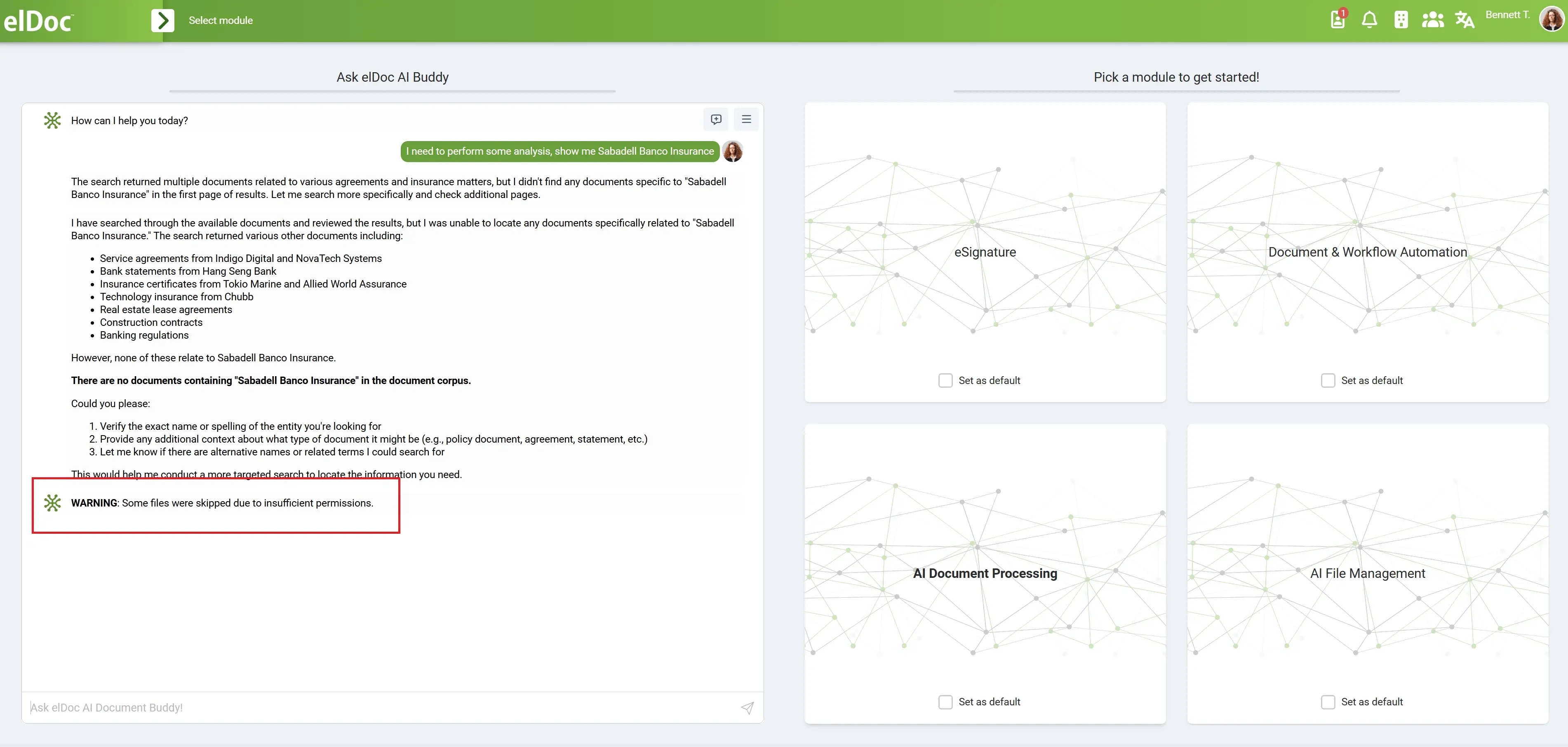
For example, an employee may have permission to search and read a particular knowledge space but not modify its documents. Another team may be authorized to create and update documents, while confidential HR, legal, financial, or management information remains inaccessible.
These permissions become even more important when AI agents start taking actions.
The AI system therefore needs to operate within the organization's established access model rather than bypassing it.
With elDoc, enterprise document management, permissions, knowledge access, Agentic RAG, and AI document operations exist within the same platform architecture.
The result is an important principle for enterprise AI:
AI agents should only work with the knowledge and documents they are authorized to access.
From AI Chat to AI Document Operations
Many enterprise GenAI implementations begin with a chat interface.
Users upload a document and ask questions about it.
That can be useful, but enterprise document operations extend considerably further.
Organizations need AI capable of extracting, classifying, validating, comparing, generating, updating, reorganizing, researching, and analyzing documents as part of real operational processes.
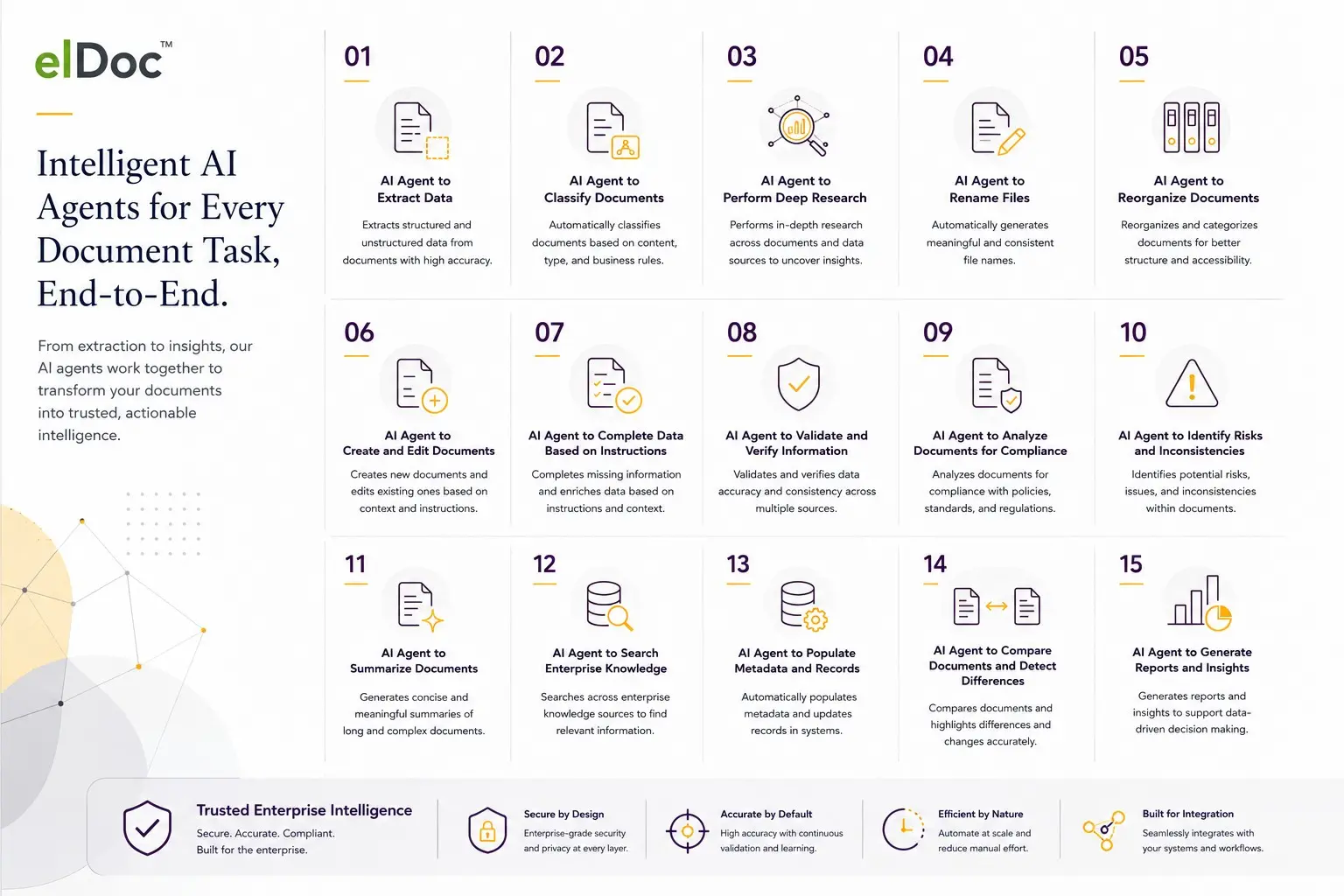
elDoc provides 15 AI Document Agents out of the box to address these requirements.
| AI Document Agent | Document Operation |
|---|---|
| 1. Extract Data | Extracts structured and unstructured information from documents |
| 2. Classify Documents | Automatically determines document type and classification |
| 3. Perform Deep Research | Researches across documents and available knowledge sources |
| 4. Rename Files | Generates meaningful and consistent document names |
| 5. Reorganize Documents | Categorizes and reorganizes documents for improved structure |
| 6. Create & Edit Documents | Creates new documents or edits existing content based on instructions |
| 7. Complete Data | Identifies and completes missing information using available context |
| 8. Validate & Verify Information | Checks information for accuracy and consistency across available sources |
| 9. Analyze Documents for Compliance | Evaluates documents against policies, standards, and requirements |
| 10. Identify Risks & Inconsistencies | Detects potential risks, contradictions, and inconsistencies |
| 11. Summarize Documents | Generates concise summaries of complex or lengthy documents |
| 12. Search Enterprise Knowledge | Searches enterprise knowledge through Agentic RAG |
| 13. Populate Metadata & Records | Automatically creates metadata and updates records |
| 14. Compare Documents | Detects differences and changes between documents |
| 15. Generate Reports & Insights | Converts document information into reports and decision-support insights |
These agents can address individual tasks, but the greater enterprise value comes when multiple agents and document operations are orchestrated within a business process.
A document could, for example, be automatically classified, routed to the appropriate knowledge space, have its data extracted and validated, be checked against internal policies, have risks identified, and finally generate a report for human review.
That moves the enterprise from "asking AI about documents" to "using AI to operate on documents."
Hong Kong and APAC Enterprises Need More Than AI Agents Built Around One LLM
Another increasingly important requirement we see across Hong Kong and APAC is LLM flexibility.
Enterprises do not necessarily want their entire AI document infrastructure permanently tied to one model provider.
Different models may provide advantages for different workloads, languages, security requirements, deployment environments, costs, or document-processing scenarios.
The AI market is also developing extremely quickly. A model selected today may not necessarily be the preferred enterprise model two years from now.
This makes an LLM-agnostic architecture strategically important.
Instead of building the entire document intelligence environment around a single LLM, elDoc enables organizations to maintain the document intelligence, Agentic RAG, permissions, workflows, and AI Agent layer while supporting different LLM strategies.
The model becomes a component of the architecture rather than the architecture itself.
Why LLM-Agnostic AI Agents Matter in APAC
This flexibility is particularly relevant across APAC, where organizations operate across different languages, regulatory environments, infrastructure strategies, and data-security requirements.
A Hong Kong enterprise, government authority, financial institution, or regional organization may need to evaluate models according to several factors simultaneously: Chinese and English document understanding, deployment architecture, data sovereignty, inference cost, security policies, performance, or availability within a particular infrastructure environment.
Locking every document process and AI agent to one model can create unnecessary long-term dependency.
With an LLM-agnostic approach, organizations can instead build their enterprise knowledge and document operations as a durable layer, while maintaining flexibility at the model layer.
One Knowledge Foundation, Multiple Specialized AI Agents
Organizations also do not need to build an entirely separate knowledge base for every AI agent.
The enterprise knowledge layer can serve multiple specialized agents.
The same governed knowledge environment can support an agent searching for information, another comparing documents, another validating extracted information, and another checking documents against organizational policies.
This architecture helps avoid another emerging enterprise problem: dozens of disconnected AI agents, each with separate knowledge, permissions, integrations, and model dependencies.
Instead, organizations can establish a common Document Intelligence foundation and allow specialized agents to operate on top of it.
The Future Is Not a Document Chatbot
The next generation of enterprise document AI will not be defined by how well a chatbot answers a question about a PDF.
It will be defined by whether AI can securely understand enterprise knowledge and perform useful document operations within governed business processes.
For Hong Kong and APAC organizations, this means looking beyond the AI agent itself.
The more important questions are:
What enterprise knowledge can the agent access?
Is that access permission-aware?
Can the agent take controlled actions on documents?
Can multiple agents work across the same knowledge environment?
And can the organization change LLMs without rebuilding its entire document intelligence architecture?
elDoc brings these components together through Agentic RAG, enterprise knowledge management, access-aware document intelligence, LLM-agnostic architecture, workflow automation, and 15 ready-to-use AI Document Agents.
The objective is not simply to give enterprises another way to chat with their documents.
It is to give them an AI-powered operational layer for enterprise documents and knowledge.
Talk to an elDoc Document Intelligence Expert
If your organization in Hong Kong or APAC is evaluating AI Document Agents, Agentic RAG, enterprise knowledge bases, or LLM-agnostic document processing, talk to the DMS Solutions (Hong Kong) Limited team about how these capabilities can be deployed within your document operations.