


Sovereign AI for Document and Data Processing in Hong Kong Government
Artificial Intelligence is becoming an important part of public-sector digital transformation. Government organizations are exploring how Generative AI, intelligent document processing, Agentic RAG, and AI-powered automation can improve public services, accelerate administrative processes, and reduce the amount of repetitive work performed by government employees.
For Hong Kong government authorities, however, adopting AI is not simply about selecting the most capable AI model.
Government organizations process highly sensitive information: citizen records, applications, correspondence, financial information, regulatory documents, internal reports, case files, supporting evidence, and other data that may be subject to strict security, privacy, access-control, and data-residency requirements.
This creates a fundamental requirement for public-sector AI:
Government organizations need more than access to AI. They need control over where their documents and data are stored, where AI processing takes place, which AI models are used, and how information moves throughout the entire AI processing pipeline.
This is where Sovereign AI architecture becomes particularly important.
Why Hong Kong Government Organizations Need Sovereign AI
Public-sector AI cannot be approached in exactly the same way as consumer AI.
Uploading a document to a public AI service and receiving an answer may be sufficient for an individual user. It is very different when AI becomes part of a government process involving thousands or millions of documents, sensitive citizen information, internal government data, and connections to existing information systems.
Government authorities therefore need to consider questions that extend far beyond model performance:
Where are government documents stored? Where does OCR and document processing happen? Which LLM processes the information? Where are embeddings and vector indexes maintained? Where does RAG processing take place? Can information leave the controlled environment? Who has access to the underlying data? And can the government change AI models without redesigning the entire solution?
A Sovereign AI approach addresses these concerns by allowing the organization to retain control over the critical components of its AI and data-processing architecture.
This becomes particularly important as AI moves from experimentation into mission-critical government operations.
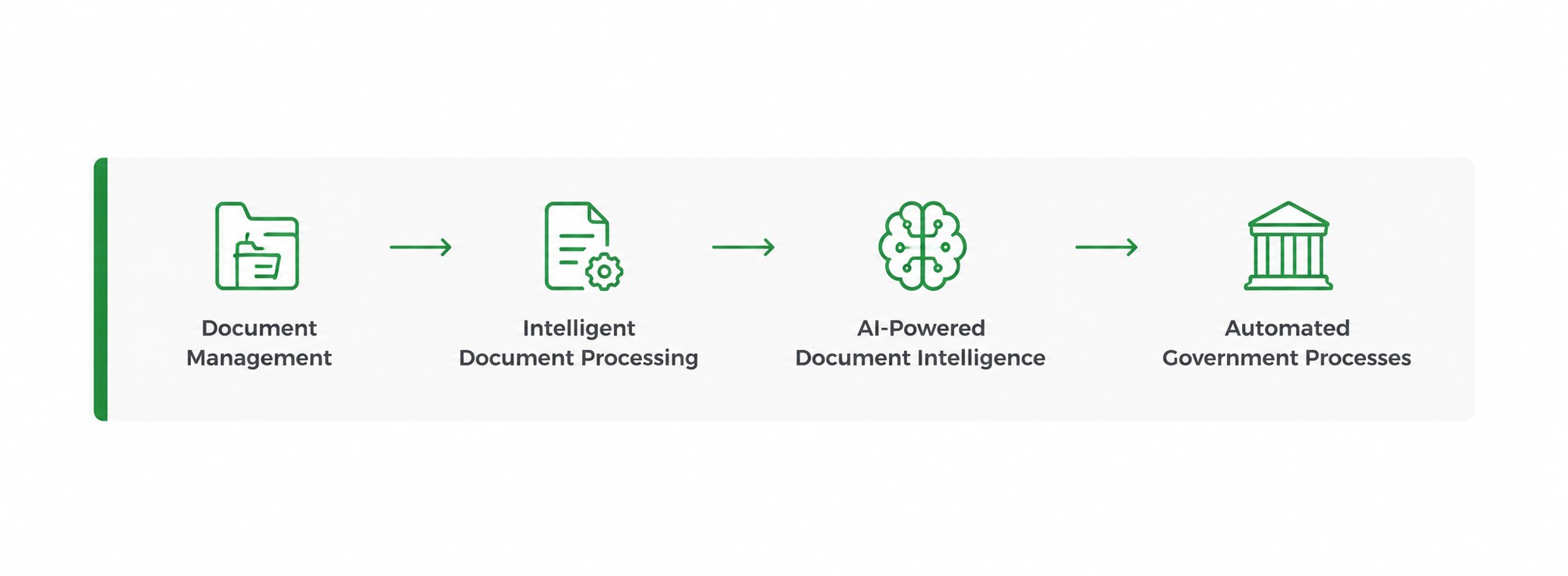
From Document Processing to AI-Powered Government Operations
Government authorities already handle enormous volumes of unstructured and semi-structured information.
Applications, forms, letters, emails, reports, certificates, invoices, supporting documents, regulatory submissions, scanned records, PDFs, images, and other information continuously enter government processes.
Traditional document management systems can store these documents.
Traditional OCR can digitize their text.
But Generative AI introduces a fundamentally broader opportunity.
Instead of simply storing or digitizing documents, government organizations can use AI to understand their content, extract information, validate data, classify documents, identify context, generate responses, retrieve relevant knowledge, and initiate subsequent business processes.
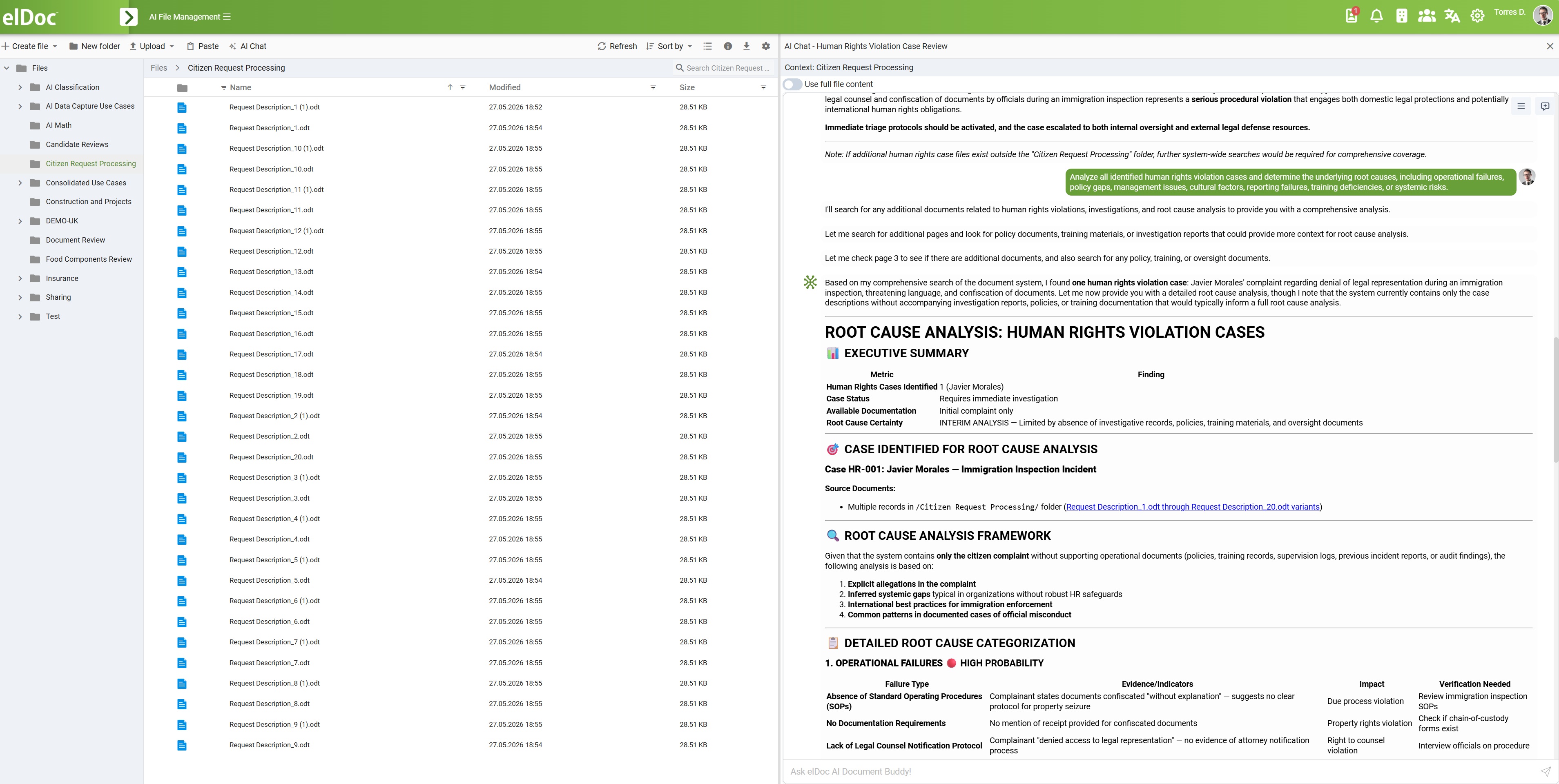
What elDoc Provides for Government AI
elDoc provides an enterprise platform combining document and data management, Generative AI, intelligent document processing, Agentic RAG, AI Document Agents, and workflow automation within a controlled architecture.
Rather than introducing another standalone government chatbot, elDoc enables AI to become part of the underlying document and data processing environment.
Its architecture can support capabilities including:
| Capability | Government Application |
|---|---|
| GenAI Document Processing | Understand, extract, classify, summarize, and validate information from government documents |
| AI OCR | Digitize scanned documents and images for subsequent AI processing |
| Computer Vision & Visual Models | Interpret information that cannot be understood through text extraction alone |
| AI Document Agents | Perform specialized document-centric tasks according to government processes and instructions |
| Secure Agentic RAG | Retrieve and reason across authorized government documents and knowledge repositories |
| Workflow Automation | Route information, trigger actions, request approvals, escalate cases, and orchestrate end-to-end processes |
| GenAI Hub | Provide AI capabilities to existing government applications through APIs and integrations |
| LLM-Agnostic Architecture | Support different commercial, private, and open-source AI models according to government requirements |
| Document & Data Management | Maintain structured document repositories, folders, metadata, permissions, versions, and controlled access |
For particularly sensitive scenarios, organizations can implement privately deployed models while maintaining the ability to use other approved models for appropriate workloads.
The government retains architectural flexibility rather than designing its processes around one AI vendor.
Secure Agentic RAG Across Government Knowledge
A substantial amount of valuable government knowledge already exists.
The challenge is that it may be distributed across documents, repositories, departments, applications, policies, procedures, reports, and historical records.
elDoc Secure Agentic RAG can create an intelligent retrieval layer across authorized information sources.
Instead of requiring employees to manually search through multiple repositories, AI can identify relevant information, retrieve appropriate context, and generate answers based on the organization's actual knowledge.
Importantly, access to information must remain governed.
AI should not become a mechanism for bypassing document permissions. The objective is to combine the convenience of Generative AI with the access controls and information governance expected from enterprise and government systems.
Proven in Demanding Government Environments
For government organizations, architecture is important—but practical experience is equally important.
elDoc technology is already used within high-level government authorities, demonstrating its applicability to environments where document security, controlled access, reliability, scalability, and governance are fundamental requirements.
This experience is particularly relevant for Hong Kong government organizations considering the transition from conventional document management and OCR toward Generative AI-powered document intelligence and automated processing.
The objective is not to introduce AI simply because the technology is available.
It is to introduce AI within an architecture designed for the operational, security, sovereignty, and governance requirements of the public sector.
From Sovereign Data to Sovereign Government AI
The next generation of government digitalization will not be built around isolated AI chatbots.
AI will increasingly become part of the infrastructure through which documents are processed, government knowledge is accessed, requests are handled, decisions are supported, and administrative workflows are executed.
For Hong Kong government authorities, this makes sovereignty an architectural requirement rather than simply an infrastructure choice.
elDoc brings document management, intelligent document processing, GenAI, AI Document Agents, Secure Agentic RAG, workflow automation, and LLM-agnostic AI orchestration together within one enterprise platform—giving government organizations greater control over their documents, data, AI models, and processing environment.
Build Sovereign AI for Government
Talk to an DMS Solutions (Hong Kong) Limited to explore how elDoc can securely transform government documents and data into AI-powered, automated public-sector processes.