


Best Knowledge Base Software: What to Look For in an AI-First Document Intelligence Solution
Enterprise knowledge bases are changing.
For years, knowledge base software was primarily designed to store, categorize, search, and retrieve information. Documents were uploaded, metadata was assigned, permissions were configured, and users relied on folders, keywords, and increasingly sophisticated search engines.
Generative AI has fundamentally changed what organizations should expect from a knowledge platform.
An AI-first knowledge base should not simply help employees find a document. It should allow users and AI Agents to securely understand organizational knowledge, retrieve the right context, analyze documents, generate new content, extract information, and perform document operations—while respecting enterprise access controls.
This is where elDoc stands out as a Document and Knowledge Intelligence Platform built around Agentic RAG, ready-to-use AI Document Agents, enterprise security, LLM-agnostic architecture, flexible deployment, and scalable document infrastructure.
What Should the Best AI Knowledge Base Software Provide?
When evaluating modern knowledge base platforms, organizations should look beyond the question:
“Can I connect an LLM to my documents?”
Connecting an LLM to a collection of files is relatively easy. Building a production-ready enterprise knowledge environment around it is considerably more complex.
An enterprise AI knowledge base should address several fundamental requirements:
| Capability | Why It Matters |
|---|---|
| Agentic RAG | Enables AI to intelligently retrieve and work with relevant enterprise knowledge |
| Granular Access Controls | Ensures AI only accesses information the requesting user is authorized to access |
| AI Document Agents | Moves beyond Q&A toward actual document operations |
| LLM-Agnostic Architecture | Avoids dependency on a single AI model or provider |
| Automatic Indexing | Makes newly uploaded knowledge available without lengthy AI training projects |
| AI OCR | Makes scanned and image-based documents accessible to AI |
| Audit Trail | Provides traceability over document and user activities |
| Flexible Deployment | Supports cloud, private cloud, hybrid, and on-premises requirements |
| High Availability | Supports business-critical enterprise knowledge environments |
| Horizontal & Vertical Scaling | Allows the platform to grow with document volumes and workloads |
| Enterprise Security Framework | Protects sensitive organizational knowledge throughout its lifecycle |
These capabilities are particularly important for enterprises, government authorities, financial institutions, professional services organizations, and other businesses operating in highly regulated environments.
1. Agentic RAG: The Foundation of an AI-First Knowledge Base
Traditional Retrieval-Augmented Generation (RAG) generally follows a straightforward model: retrieve relevant information and provide it as context to an LLM.
Enterprise knowledge environments require considerably more.
Agentic RAG allows AI Agents to interact dynamically with enterprise knowledge and determine how information should be retrieved and used for a particular operation.
With elDoc, Agentic RAG sits at the center of the knowledge architecture.
Documents uploaded into the platform become part of an intelligent, searchable knowledge environment that can be used by authorized users and AI Agents.
This enables organizations to move from:
Store → Search → Open → Read
toward:
Ask → Retrieve → Understand → Analyze → Act
The knowledge base therefore becomes an operational AI layer rather than simply another document repository.
How elDoc Enables Multilingual Agentic RAG
elDoc is designed for organizations where enterprise knowledge exists across multiple languages.
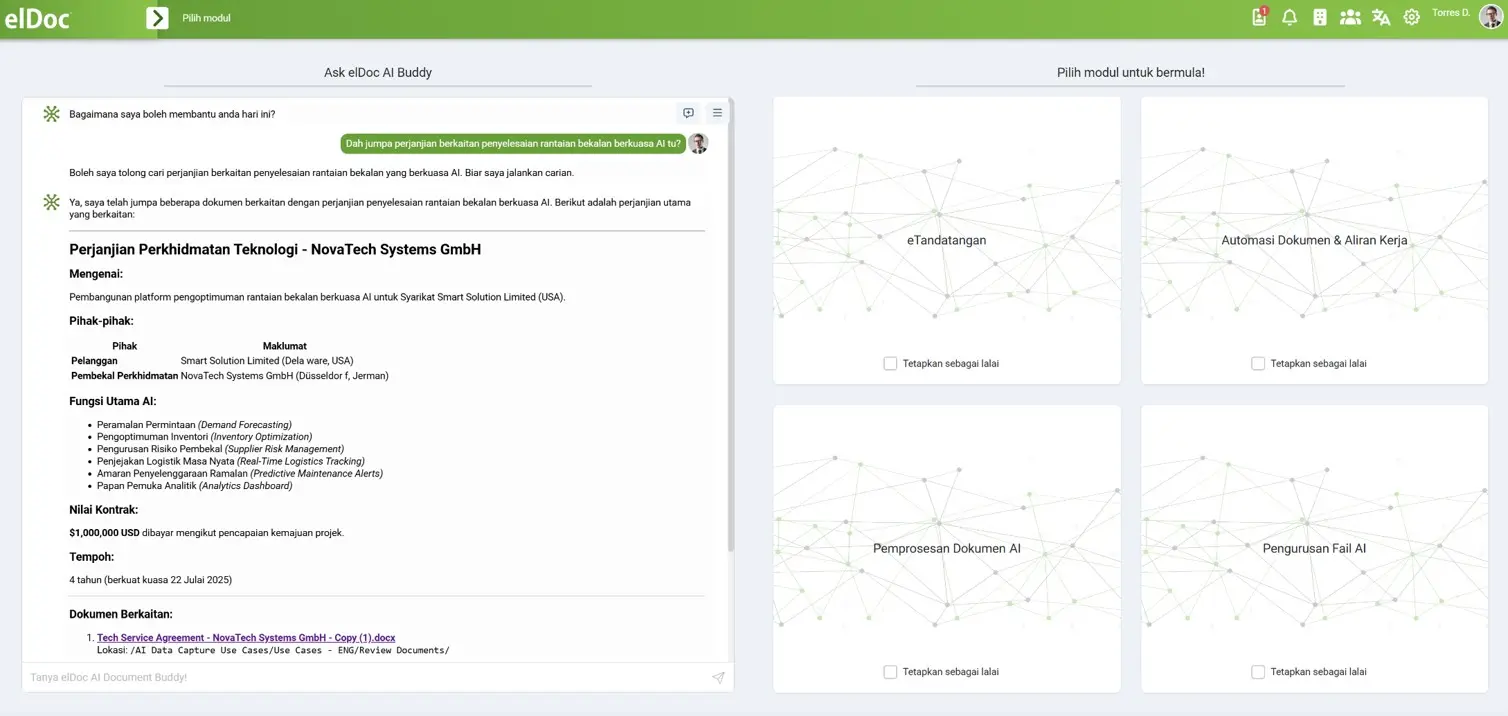
Documents stored in the Knowledge Base can be in English, Traditional Chinese, Simplified Chinese, Japanese, Korean, Bahasa Melayu, Indonesian, Vietnamese, Spanish, and other languages, while users can interact with this knowledge in a different language.
For example, an organization may have thousands of documents in English and Chinese, while an employee asks a question in Spanish or Bahasa Melayu.
With elDoc Agentic RAG, the user does not need to know which language the relevant document is written in. elDoc can retrieve relevant knowledge from the indexed document environment, provide the appropriate context to the selected LLM, and enable the answer to be generated in the user's requested language.
English & Chinese Documents → elDoc Agentic RAG → Question in Spanish → Answer in Spanish
This is enabled through elDoc's combination of multilingual document processing, AI OCR, automatic indexing, Agentic RAG, and LLM-agnostic architecture.
Scanned documents can first be processed through AI OCR. Uploaded content is indexed and made available to the knowledge environment without requiring organizations to manually train elDoc on every document collection. Agentic RAG can then retrieve relevant information across the authorized knowledge base, while the selected multilingual LLM interprets the context and generates the response in the required language.
The same principle applies across different language combinations. A user in Malaysia can interact in Bahasa Melayu with knowledge originally stored in English, while a user in Hong Kong can query knowledge distributed across English and Chinese documents.
This allows international organizations to maintain documents in their original business languages while creating a multilingual AI knowledge layer on top of them.
For enterprises operating across Hong Kong and APAC, this is particularly important: the Knowledge Base does not have to be separated by language, and users do not have to manually translate documents before they can search, understand, and work with organizational knowledge through AI.
2. Access-Aware AI Is Critical
One of the biggest differences between a consumer AI application and an enterprise knowledge platform is authorization.
Imagine an organization containing HR records, contracts, financial information, management documents, customer records, technical documentation, and confidential project information.
An AI system cannot simply retrieve everything.
If an employee asks a question, the AI must operate within the same information boundaries established by the organization.
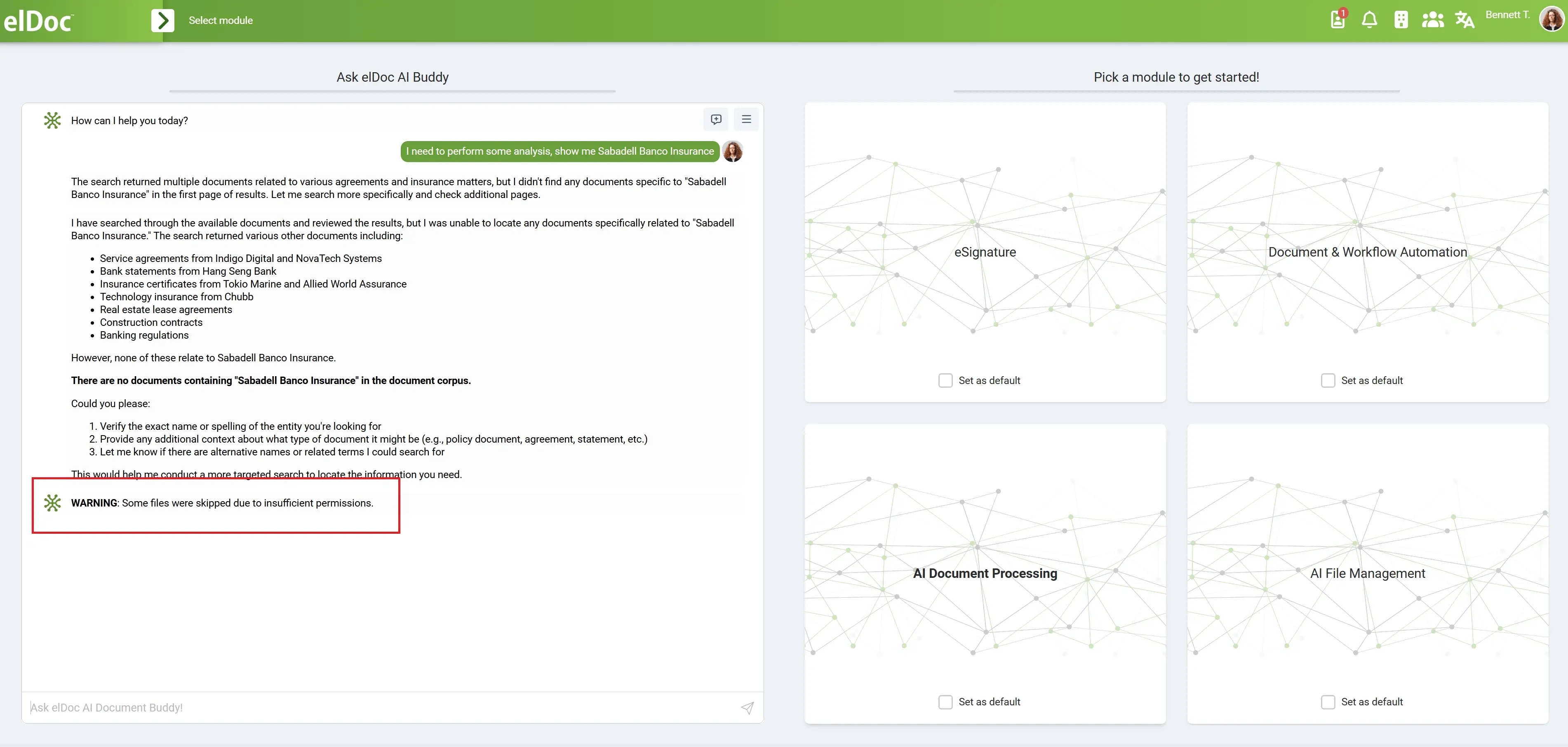
This is why elDoc combines its knowledge environment with robust document and file access controls.
Organizations can manage access for individual users and groups and control which information can be viewed or worked with.
The principle is simple:
AI access to knowledge should never automatically mean unrestricted access to organizational data.
This makes access-aware Agentic RAG an essential capability for enterprise adoption.
3. From Knowledge Retrieval to AI Document Agents
A knowledge base becomes significantly more valuable when AI can do something with the information it retrieves.
elDoc provides 15 ready-to-use AI Document Agents out of the box, designed for different document and knowledge operations.
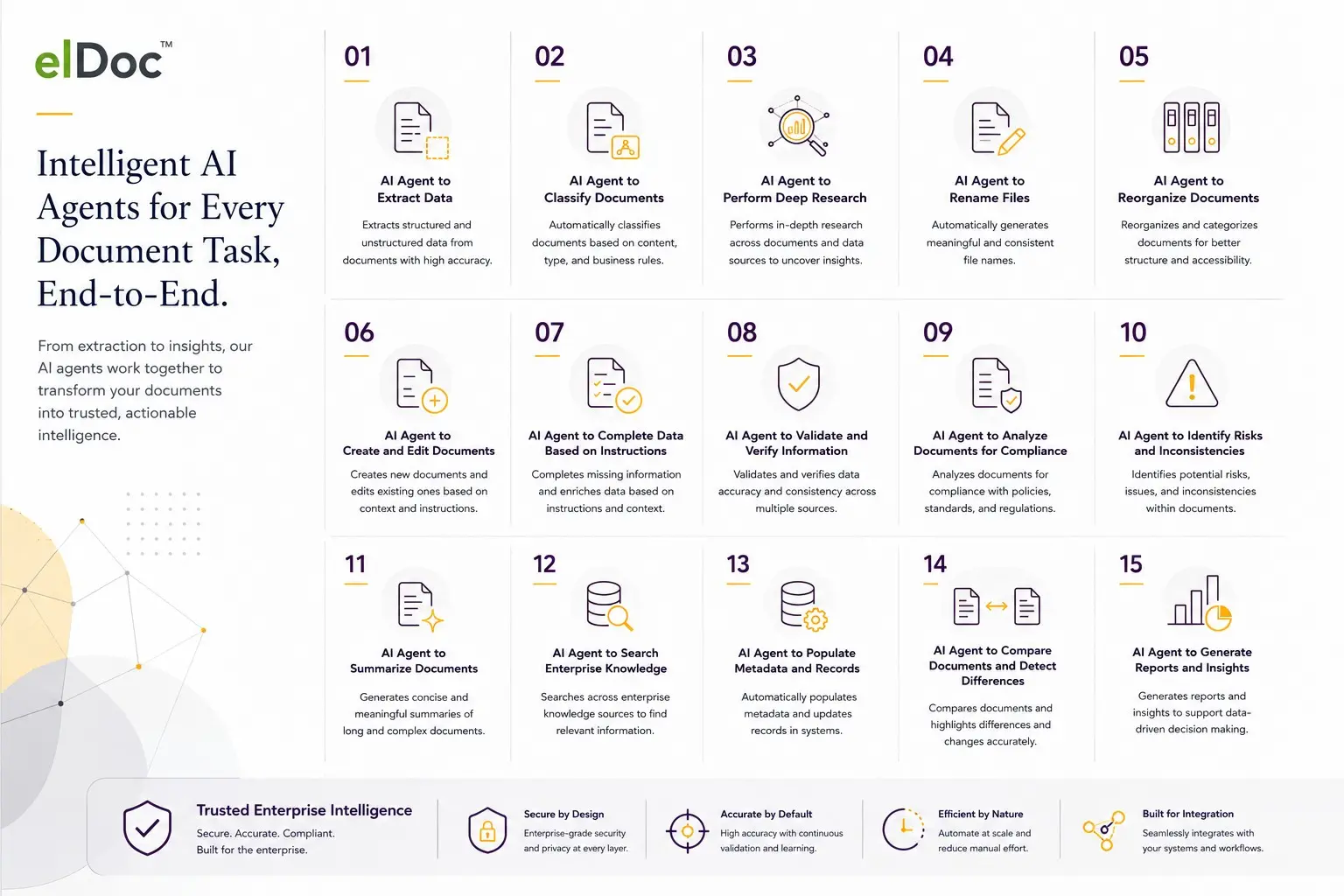
Instead of limiting employees to questions such as:
“What does this contract say about termination?”
AI Agents can support broader document-centric operations involving analysis, extraction, comparison, summarization, content generation, and other knowledge-intensive processes.
This creates an important distinction.
Traditional AI Knowledge Base
Documents → RAG → LLM → Answer
elDoc AI-First Knowledge Platform
Documents → Document Intelligence → Agentic RAG → AI Agents → Business Operations
Organizations therefore do not need to build every AI document capability from scratch before they can start applying GenAI to their enterprise knowledge.
4. No AI Training Required for Your Knowledge Base
Another common misconception is that enterprises must “train AI on their documents” before they can create an intelligent knowledge base.
With elDoc, this is not required.
When documents are uploaded, they can be processed, indexed, and made available to the knowledge environment.
For scanned documents and image-based content, AI OCR can transform previously inaccessible information into machine-readable content that can subsequently be indexed and made available to the Agentic RAG pipeline.
This is especially important for organizations with years—or even decades—of accumulated documents.
Instead of launching a lengthy model-training initiative every time organizational knowledge changes, the knowledge environment can continuously evolve as information is added.
Upload → Process → OCR where required → Index → Make available to Agentic RAG
New organizational knowledge can therefore become useful to AI much faster.
5. LLM-Agnostic Architecture
The best knowledge base software should not assume that one LLM will remain the best choice forever.
Enterprise AI is evolving extremely quickly.
Organizations may require different models depending on:
elDoc is designed around an LLM-agnostic architecture, giving organizations greater flexibility in how AI capabilities are deployed and consumed.
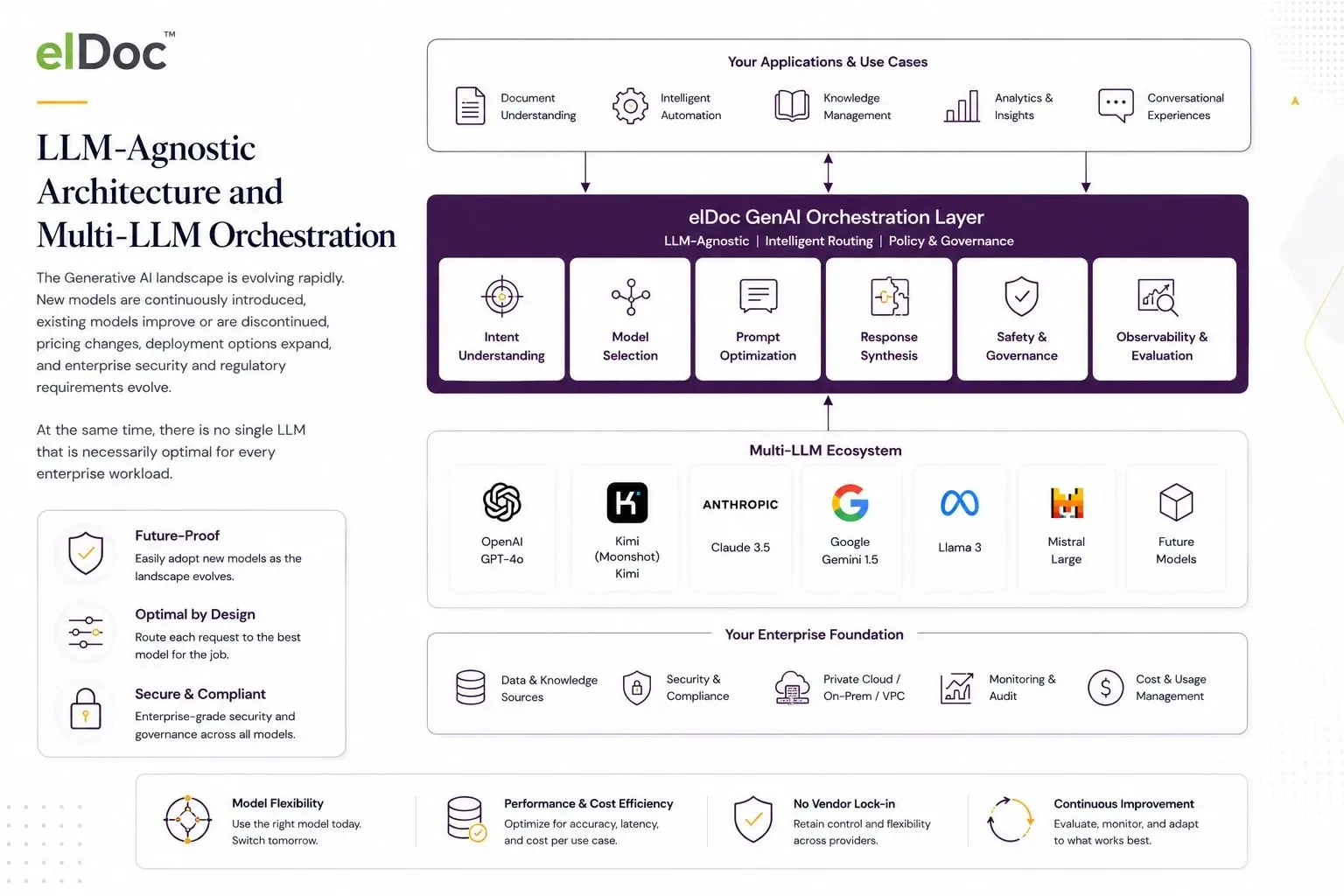
This is particularly relevant across Hong Kong and APAC, where organizations can have very different requirements regarding public-cloud AI services, private infrastructure, data sovereignty, and regulated information.
The knowledge architecture should adapt to the enterprise—not force the enterprise to redesign its AI strategy around a single model or AI provider.
6. Security Framework for Enterprise Knowledge
A knowledge base may eventually contain some of an organization's most valuable and sensitive information.
That makes security architecture just as important as AI capability.
elDoc approaches Knowledge Intelligence as part of a broader enterprise Document Intelligence environment rather than treating security as an additional layer attached to a chatbot.
The platform combines access controls, document permissions, user and group management, controlled AI access, auditability, and deployment flexibility to help organizations maintain governance over how their information is accessed and processed.
For regulated organizations, the question should therefore not only be:
“How intelligent is the AI?”
It should also be:
“How much control do we retain over our data, users, AI models, document access, and infrastructure?”
7. Comprehensive Audit Trail
Enterprise AI operations also require accountability.
Organizations need visibility into activity across their knowledge environment, particularly when sensitive documents and regulated business information are involved.
elDoc provides a comprehensive audit trail that supports greater transparency and traceability of activities within the document and knowledge environment.
This becomes increasingly important as organizations progress from employees manually accessing documents toward AI Agents interacting with enterprise knowledge.
The more AI becomes integrated into business operations, the more important governance, accountability, and traceability become.
8. Flexible Deployment Scenarios
There is no single deployment architecture suitable for every enterprise.
A small business adopting an AI knowledge base may have very different requirements from a government authority, bank, insurance company, or large multinational organization.
elDoc supports flexible deployment scenarios designed to accommodate different infrastructure, security, data residency, and regulatory requirements.
Depending on the organization's architecture, regulatory obligations, and AI strategy, elDoc can support environments where greater control over infrastructure and data processing is required, including private and on-premises deployment scenarios.
This flexibility is particularly valuable for organizations developing Sovereign AI strategies or looking to process sensitive knowledge without becoming entirely dependent on external AI infrastructure.
9. High Availability for Business-Critical Knowledge
Once AI becomes embedded into everyday operations, the knowledge platform supporting it can become business-critical infrastructure.
High availability therefore needs to be considered at the architectural level.
Organizations should evaluate whether a knowledge platform is designed for enterprise production workloads—not simply successful AI demonstrations or small proof-of-concept projects.
elDoc's architecture is designed to support high-availability deployment scenarios, helping enterprises build resilient Document and Knowledge Intelligence environments for business-critical operations.
This becomes particularly important when multiple applications, employees, workflows, integrations, and AI Agents depend on the same organizational knowledge layer.
10. Scalability to Terabytes of Enterprise Knowledge
Enterprise knowledge does not stop growing.
Organizations continuously generate contracts, correspondence, reports, invoices, forms, presentations, policies, technical documents, customer records, scanned archives, and other forms of structured and unstructured information.
An AI knowledge platform therefore needs to scale far beyond small proof-of-concept datasets.
elDoc's architecture is designed for large-scale document environments reaching multiple terabytes of data, with infrastructure that can be expanded according to organizational requirements.
Horizontal Scaling
Additional infrastructure resources can be introduced to distribute workloads and support increasing volumes of documents, users, AI processing, Agentic RAG requests, workflows, and transactions.
Vertical Scaling
Individual infrastructure components can be provided with greater computational resources as document processing and AI workload requirements increase.
Together, horizontal and vertical scaling allow organizations to design an elDoc environment around current requirements while retaining the ability to expand as document volumes, users, integrations, and AI workloads grow.
This is especially important for large enterprises and government organizations processing millions of documents, terabytes of enterprise knowledge, or extensive historical archives.
Why elDoc Stands Out as AI-First Knowledge Base Software
Many Knowledge Base products started as search platforms, wikis, document repositories, or chat applications and subsequently added Generative AI and RAG.
elDoc approaches the challenge differently.
elDoc has been built around enterprise Document and Knowledge Intelligence, combining:
Enterprise Document Management + AI OCR + Document Intelligence + Agentic RAG + AI Document Agents + LLM-Agnostic Architecture + Workflow Automation + Enterprise Security & Governance
But architecture alone does not make an enterprise Knowledge Base production-ready.
Production Readiness Must Be Proven
There is a significant difference between demonstrating an AI Knowledge Base in a proof of concept and operating one across a large organization.
Enterprise environments may involve millions of documents, terabytes of data, complex user permissions, multiple departments, concurrent AI workloads, integrations, audit requirements, and business-critical availability.
elDoc is not approaching these requirements as a future roadmap.
The platform has a substantial base of implementations across government organizations, critical infrastructure environments, and large commercial enterprises, providing real-world validation of its scalability, security, availability, and enterprise architecture.
These organizations require much more than accurate AI answers. They need robust access controls, comprehensive auditability, scalable infrastructure, deployment flexibility, high availability, and reliable processing of large document volumes.
From LLM Experiments to Operational Knowledge Intelligence
While many organizations and technology providers are still experimenting with connecting LLMs to documents, elDoc already provides the broader infrastructure required to operationalize enterprise knowledge:
Documents → AI OCR → Automatic Indexing → Access-Aware Knowledge → Agentic RAG → AI Document Agents → Enterprise Operations
Organizations therefore do not have to assemble document management, RAG, security, OCR, AI Agents, workflows, and governance as separate components.
With elDoc, these capabilities operate within one Document and Knowledge Intelligence environment.
The result is not simply another “chat with your documents” solution. It is an architecture where enterprise knowledge can be securely stored, processed, retrieved, understood, governed, and acted upon by employees and AI Agents.
Choosing the Best Knowledge Base Software for the AI Era
Organizations evaluating AI Knowledge Base software should look beyond impressive chatbot demonstrations.
Ask whether the platform can manage millions of documents and terabytes of enterprise knowledge. Ask whether AI respects user, group, and document permissions. Ask whether scanned documents automatically become part of the AI-accessible knowledge environment. Ask whether users can interact with knowledge across different languages. Ask whether you are locked into one LLM. Ask whether AI Agents can perform real document operations. And ask whether the platform has actually been proven in demanding production environments.
Production readiness is not something that can simply be promised—it must be demonstrated through real implementations.
This is where elDoc stands out. Its architecture is supported by deployments across government, critical infrastructure, and large commercial environments, while Agentic RAG and 15 ready-to-use AI Document Agents extend that established enterprise foundation into the Generative AI era.
With Agentic RAG, AI Document Agents, multilingual knowledge retrieval, LLM-agnostic architecture, AI OCR, access-aware AI, audit trails, enterprise security, flexible deployment, high availability, and horizontal and vertical scalability, elDoc delivers more than an AI interface to documents.
Talk to DMS Solutions Hong Kong Limited experts and discover how to implement a secure, enterprise-ready AI Knowledge Base with a built-in security framework from day one