


Enterprise Knowledge Base with LLM: Why Connecting AI to Your Documents Is Not Enough
Enterprises across Hong Kong and the wider APAC region are increasingly looking to build AI Knowledge Bases that allow employees to ask questions, retrieve information, analyze documents, and work with organizational knowledge through Large Language Models (LLMs).
At first glance, the concept appears straightforward:
Connect an LLM to company documents → ask questions → receive answers.
But this is exactly where many enterprise Knowledge Base initiatives begin to fail.
An enterprise Knowledge Base is not simply a chatbot connected to a folder of documents.
Organizations need to control where knowledge is stored, who can access it, what AI is permitted to retrieve, how scanned and unstructured documents are processed, how information is indexed, and how the AI determines which knowledge can be used for each individual user.
This requires much more than an LLM.
It requires an enterprise Knowledge Intelligence architecture built around Agentic RAG, document intelligence, access-aware retrieval, and controlled file management.
This is the approach behind elDoc.
Why Simply Connecting an LLM to Your Documents Does Not Work
An LLM is extremely capable at understanding and generating language, but it does not automatically understand an organization's internal knowledge.
Your enterprise information may be distributed across:
Connecting these files to an LLM does not automatically create an enterprise-ready Knowledge Base.
The bigger questions are:
Which documents can the AI access?
Which documents can a particular employee access?
Should the AI be allowed to retrieve information from confidential folders when answering that employee?
What happens when a document is scanned and contains no searchable text?
What happens when documents are updated, replaced, moved, or deleted?
Can different departments maintain separate knowledge spaces while still operating within the same AI environment?
These are not chatbot questions.
They are Knowledge Intelligence, information governance, security, document processing, and enterprise architecture questions.
Your AI Knowledge Base Needs a Real File Management Space
Before an AI system can intelligently work with enterprise knowledge, organizations need a controlled environment in which that knowledge can exist.
This is why elDoc combines an extended enterprise file management space with Agentic RAG.
Organizations can structure documents into relevant folders and knowledge areas while controlling how employees, departments, teams, and AI services interact with them.
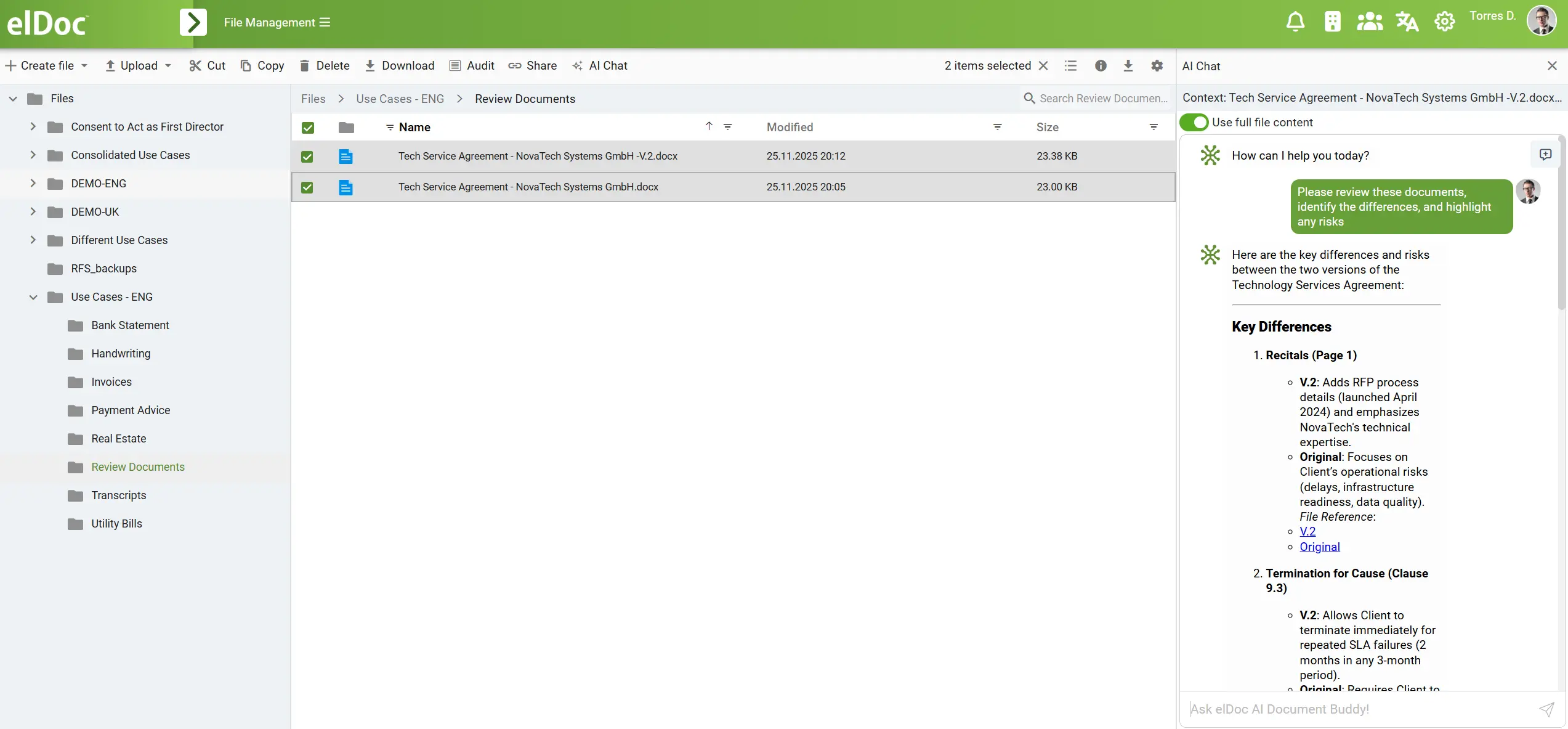
Instead of creating an isolated AI chatbot sitting beside enterprise information, the Knowledge Base becomes part of the organization's controlled information environment.
Users and groups can be assigned permissions defining whether they are permitted to:
| Permission | What It Controls |
|---|---|
| Access | Whether the user can access a particular knowledge space |
| Read | Whether documents and their information can be retrieved |
| Create | Whether new documents or information can be added |
| Edit | Whether existing information can be changed |
| Modify | Whether the user can perform permitted document operations |
This becomes particularly important when AI enters the process.
AI Must Understand Access Rights — Not Bypass Them
One of the fundamental requirements for an enterprise Knowledge Base is access-aware AI retrieval.
Consider an organization with HR, Finance, Legal, Operations, Sales, and Management knowledge stored within the same enterprise environment.
A Finance employee may be permitted to access financial policies and invoices but should not automatically receive information from confidential HR records.
Management may have access to documents unavailable to other employees.
A project team may have access only to knowledge associated with its specific project.
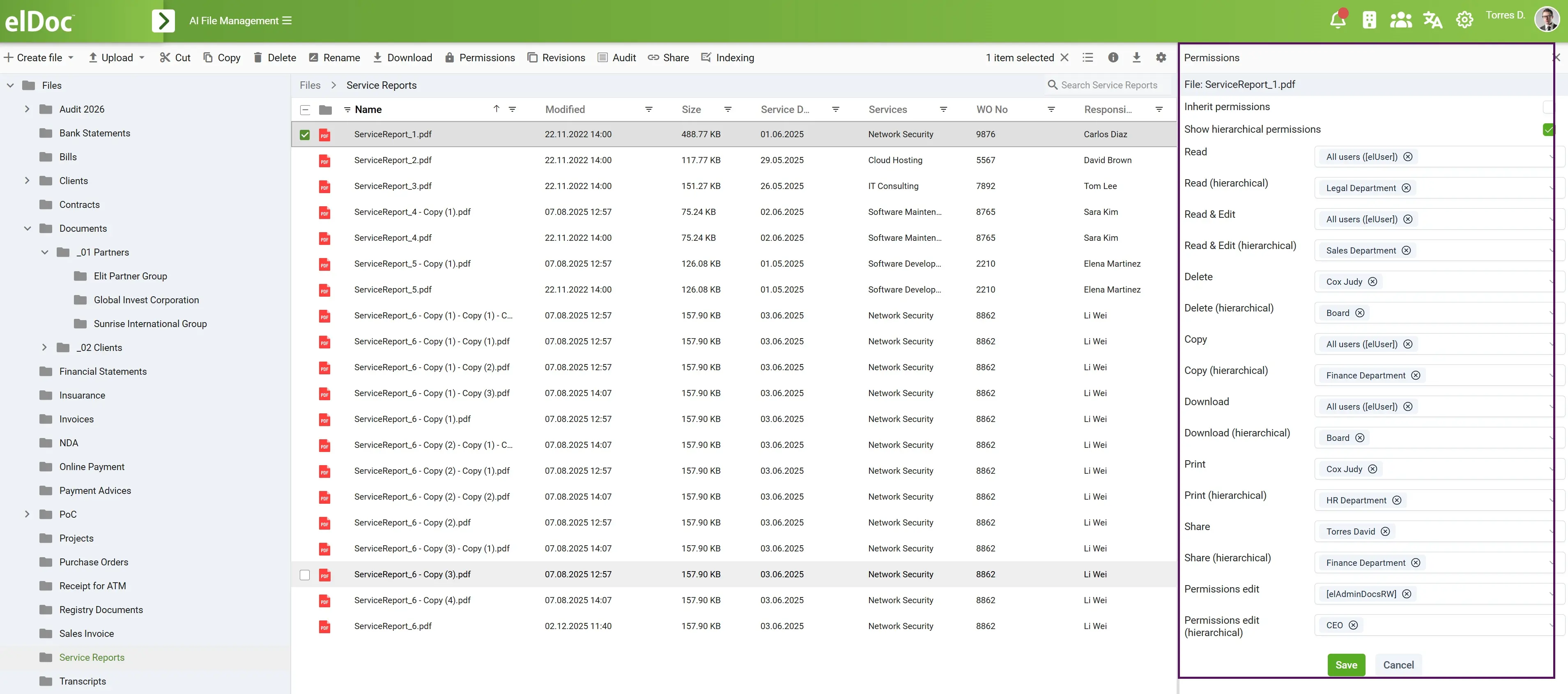
The AI therefore cannot simply search everything.
When a user interacts with the Knowledge Base, retrieval must operate within the information that the user is authorized to access.
In other words:
User access rights should become AI access rights.
This is a fundamental difference between an enterprise Knowledge Base and a generic RAG chatbot.
Why Enterprises in Hong Kong and APAC Are Struggling with Knowledge Bases
Many Knowledge Base projects still begin with the assumption that the primary objective is to create a better enterprise chat interface.
But the chat interface is only the visible layer.
Behind it, enterprises need a complete knowledge-processing pipeline capable of handling large volumes of constantly changing documents and information.
This is particularly relevant for Hong Kong enterprises, government organizations, financial institutions, regulated businesses, and larger APAC organizations, where information access, security, deployment architecture, document processing, and governance can be just as important as the quality of the LLM response.
The challenge is therefore not simply:
"How do we let employees chat with documents?"
A better question is:
"How do we build an AI environment that can securely understand and work with enterprise knowledge?"
That requires an Agentic RAG platform rather than another document chatbot.
From Basic RAG to Agentic RAG
Traditional RAG — Retrieval-Augmented Generation — generally retrieves relevant information from a knowledge source and provides that context to an LLM before generating an answer.
Enterprise knowledge environments can require considerably more.
Agentic RAG introduces an intelligent orchestration layer around retrieval and knowledge processing.
Instead of treating every request as a simple semantic search, AI agents can participate in understanding the request, identifying relevant knowledge, retrieving appropriate information, processing context, and supporting subsequent actions.
The objective is not merely to find text that looks similar to the user's question.
It is to create an AI layer capable of reasoning across authorized organizational knowledge.
This is where the Knowledge Base starts evolving into a Knowledge Intelligence Platform.
Do You Need to Train elDoc to Understand Your Knowledge?
No.
This is one of the major differences between modern GenAI-based knowledge processing and older enterprise information systems.
Organizations do not need to train elDoc separately for every document type before their information can become part of the Knowledge Base.
There is no requirement to manually build a template for every document layout before information can be processed.
Once documents are uploaded into the relevant elDoc environment, they can enter the knowledge-processing pipeline and become indexed for AI retrieval.
This significantly reduces the implementation barrier for organizations dealing with thousands or millions of documents across many different formats.
What About Scanned Documents?
Enterprise knowledge is rarely composed entirely of clean, machine-readable PDFs.
Organizations often have years of scanned documentation, archived correspondence, application forms, signed agreements, historical records, and image-based PDFs.
These files cannot simply be ignored by an enterprise Knowledge Base.
With elDoc, scanned documents can pass through AI OCR and document processing so their content can be recognized and prepared for indexing.
The process can therefore move from:
Upload → AI OCR / document processing → indexing → Agentic RAG availability
without requiring users to manually recreate the information.
A scanned document that previously existed primarily as an image can become part of the organization's searchable and AI-accessible knowledge environment.
Knowledge Becomes Available as Documents Enter the System
An enterprise Knowledge Base should not require a lengthy retraining project every time new information is introduced.
As new documents enter elDoc, they can be processed and indexed so that the Knowledge Base reflects newly available organizational information.
This is important because enterprise knowledge is never static.
Contracts change. Policies are updated. New reports arrive. New project documentation is created. Procedures are revised.
The Knowledge Base therefore needs to operate as a continuously evolving knowledge environment, rather than as a periodically trained AI model.
The LLM does not need to memorize the organization's entire document repository.
Instead, Agentic RAG retrieves relevant, authorized knowledge when it is required.
LLM-Agnostic Knowledge Architecture
Enterprises should also avoid designing their entire Knowledge Base around one LLM vendor.
Model capabilities, costs, deployment requirements, and enterprise AI strategies continue to evolve rapidly.
elDoc is designed around an LLM-agnostic architecture, allowing the knowledge layer, document processing environment, access controls, and Agentic RAG capabilities to remain distinct from dependence on a single language model.
This is especially important for organizations considering different combinations of cloud LLMs, private models, or locally deployed AI infrastructure.
The enterprise knowledge architecture should survive changes in the underlying model.
A Knowledge Base Is Infrastructure, Not a Chat Window
The most important shift is conceptual.
Enterprises should stop thinking about an AI Knowledge Base as simply:
Documents + LLM + Chat
A production enterprise Knowledge Base requires several coordinated layers:
Enterprise File Management → Access Controls → Document Processing → AI OCR → Indexing → Agentic RAG → LLM → AI Agents and Business Processes
The chat interface may still be one way users interact with knowledge.
But it is only one interface into a much broader Knowledge Intelligence infrastructure.
From Enterprise Documents to Knowledge Intelligence with elDoc
elDoc brings document management, intelligent document processing, AI OCR, access-aware knowledge retrieval, Agentic RAG, LLM connectivity, and AI Agents into a unified enterprise environment.
For organizations in Hong Kong and across APAC, this provides a path beyond experimental "chat with your documents" projects toward controlled, scalable enterprise AI.
Documents can become AI-accessible as they enter the platform. Scanned information can be recognized and indexed. Existing access controls can determine which knowledge is available to different users. Agentic RAG can provide the intelligence layer between enterprise information and the selected LLM.
The result is not simply another chatbot.
It is an enterprise Knowledge Intelligence Platform designed to make organizational knowledge securely accessible to AI and the people authorized to use it.
Talk to an elDoc Knowledge Intelligence Expert
Planning an enterprise LLM Knowledge Base, Agentic RAG implementation, secure enterprise AI environment, or AI-powered document knowledge platform in Hong Kong or APAC?
Talk to an DMS Solutions (Hong Kong) Limited expert to explore how your existing enterprise documents can be transformed into an access-aware Agentic RAG Knowledge Base — without document-by-document AI training or template configuration.