


AI Metadata Indexing for Documents: A Leading Solution for Hong Kong, Taiwan, Singapore and Malaysia
Across Hong Kong, Taiwan, Singapore, Malaysia and the wider APAC region, enterprises are managing rapidly growing volumes of documents across multiple languages, formats, business units and systems.
Contracts, invoices, application forms, correspondence, shipping documents, financial records, customer files, government documents and technical documentation all contain valuable metadata. The challenge is turning this unstructured content into accurate, searchable and actionable enterprise data without creating templates for every document type or relying on manual indexing.
elDoc brings Generative AI directly into document ingestion and metadata indexing.
Instead of requiring organizations to define rigid document templates, train extraction models for every layout, or manually populate metadata fields, elDoc can use LLMs, AI OCR, Computer Vision and intelligent document processing to understand documents and generate metadata automatically.
For organizations across APAC, this creates a fundamentally different approach:
Upload a document. Let AI understand it. Extract and generate metadata instantly. Make the information available for search, workflows, integrations and Agentic RAG.
Why AI Metadata Indexing Matters
Traditional document management often depends on users manually entering information such as document type, company name, customer number, contract number, date, department, category or other indexing attributes.
At enterprise scale, this becomes expensive and difficult to maintain.
Rule-based capture can automate part of the process, but frequently requires templates, zones, extraction rules or model training for different document layouts.
Generative AI changes this approach.
With elDoc, metadata can be generated based on the actual content and context of a document, rather than only its physical position on a page.
| Traditional Metadata Indexing | AI Metadata Indexing with elDoc |
|---|---|
| Manual data entry | AI-powered metadata generation |
| Templates for specific layouts | Template-free document understanding |
| Fixed extraction zones | Context-aware information extraction |
| Extensive setup for new formats | New documents can be processed immediately |
| Difficult multilingual configuration | Designed for multilingual document environments |
| Separate OCR and indexing processes | AI processing integrated into document ingestion |
| Limited to predefined rules | Natural-language AI instructions |
| Difficult to adapt | Configure and extend metadata according to business requirements |
Metadata Is Generated During Document Upload
One of the major advantages of the elDoc architecture is that AI metadata processing does not need to be treated as a separate project or downstream operation.
AI can start working as documents enter elDoc.
When a document is uploaded or received through an integrated business process, elDoc can orchestrate the required AI processing to:
The result is an intelligent ingestion pipeline where a document can move from unstructured content to structured enterprise information within the same processing environment.
No Templates Required
APAC enterprises frequently process documents originating from thousands of customers, suppliers, partners, government organizations and international counterparties.
Layouts change. Formats differ. Languages vary.
Building and maintaining a template for every possible document layout is therefore increasingly impractical.
elDoc uses Generative AI-based document understanding to reduce this dependency on templates.
Instead of teaching the system where a particular field is located, users can define what information they need.
For example:
Supplier name, invoice number, invoice date, purchase order number, currency, total amount, tax amount and payment terms.
The AI interprets the document and identifies the requested information based on meaning and context.
This approach can significantly accelerate implementation, particularly where organizations have a high variety of document layouts.
AI Metadata Is Captured and Populated During Document Upload
With elDoc, metadata indexing starts the moment a document is uploaded.
The AI interprets the document based on its content, meaning, and context, identifies the required information, and automatically populates the corresponding metadata fields. There is no need for users to upload a document and then manually complete multiple indexing fields afterward.
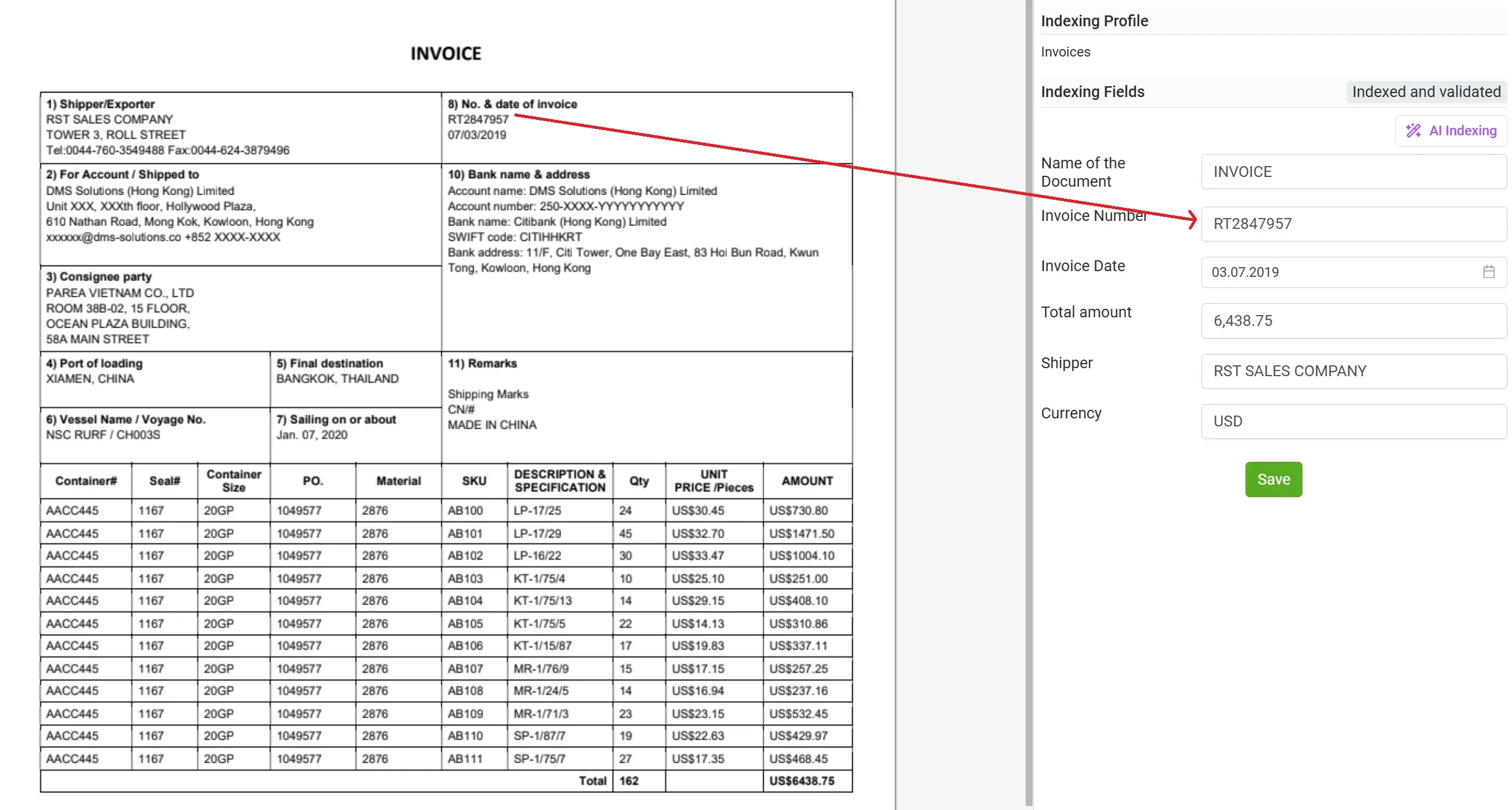
Upload → AI Understanding → Data Capture → Metadata Population → Instant Filtering & Search
For example, when a contract is uploaded, elDoc can automatically identify and populate metadata such as contract number, counterparty, contract type, effective date, expiration date, jurisdiction, and responsible department. For an invoice, it can capture supplier, invoice number, PO number, invoice date, currency, total amount, and other required business data.
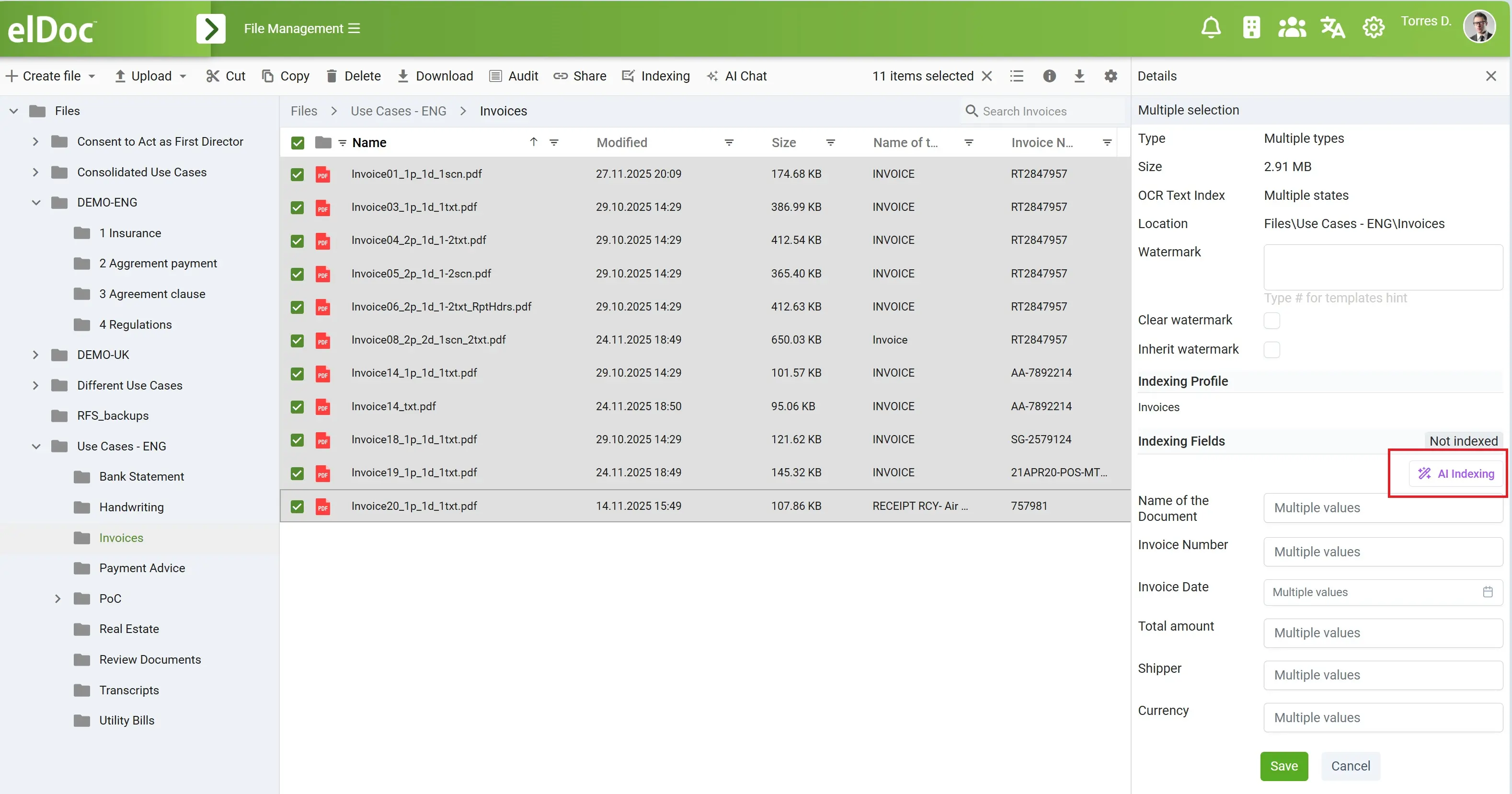
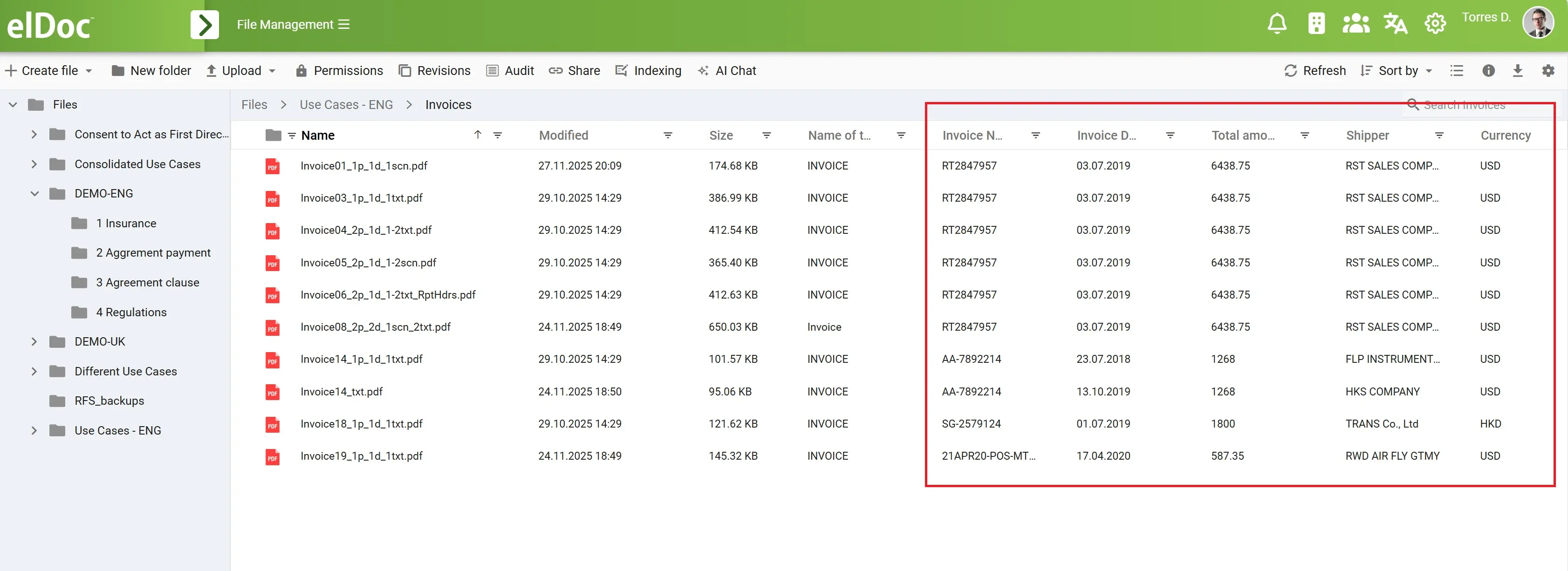
Once populated, this metadata becomes immediately available within elDoc for filtering, sorting, searching, classification, workflow routing, and downstream automation.
Because elDoc uses AI to understand information contextually rather than relying on fixed field positions, organizations can process documents with different layouts, structures, and languages without building a separate template for every format.
This is particularly valuable for enterprises in Hong Kong, Taiwan, Singapore, Malaysia, and across APAC, where document environments can be highly multilingual and organizations may receive thousands of different document layouts from customers, suppliers, partners, and internal departments.
The result is a much faster path from document upload to structured, searchable and actionable enterprise data—with significantly less configuration and manual indexing.
Different Document Types, Different AI Metadata
Not every document should be indexed in the same way. A contract, application form, invoice, purchase order, customer file, or corporate document contains different business information and therefore requires its own relevant metadata.
With elDoc, organizations can define different metadata structures for different document types. Once the document is uploaded and its type is identified, AI can capture the information relevant to that specific document category and automatically populate the corresponding metadata fields.
| Document Type | Examples of AI-Captured Metadata |
|---|---|
| Contracts | Contract number, counterparty, contract type, effective date, expiration date, jurisdiction, renewal terms |
| Application Forms | Applicant name, application number, application type, submission date, requested service, status |
| Invoices | Supplier, invoice number, PO number, invoice date, currency, tax, total amount, payment terms |
| Purchase Orders | PO number, supplier, order date, delivery date, currency, total value |
| Customer Documents | Customer name, customer ID, document category, issue date, validity date |
| Corporate Documents | Company name, document type, department, responsible person, effective date, business category |
This makes metadata business-specific rather than generic. Users working with contracts can filter documents by expiration date or counterparty, while teams processing applications can filter by applicant, application type, submission date, or status.
Different document types → Different metadata → More precise filtering, search and automation
Because elDoc combines document understanding with AI-powered data capture, organizations can build rich metadata structures around their actual business processes—without forcing every document into the same indexing model.
Built for the Multilingual Reality of APAC
Hong Kong, Taiwan, Singapore and Malaysia are highly international business environments.
A single enterprise may need to process documents containing Traditional Chinese, Simplified Chinese, English, Malay and other regional or international languages.
Hong Kong organizations, for example, can receive Chinese and English documents within the same business process. Taiwan introduces extensive Traditional Chinese content, while Singapore and Malaysia operate in highly multilingual commercial environments.
elDoc combines modern AI OCR and Generative AI capabilities to support multilingual document processing rather than designing the architecture around a single language.
This is particularly important for regional enterprises operating across several APAC markets.
One document processing architecture can support multiple languages, document types and business processes.
Any LLM: Avoid Building Metadata Automation Around a Single AI Vendor
AI technology is developing extremely quickly. An LLM that is optimal for one use case today may not necessarily be the preferred model for every future requirement.
For this reason, elDoc is designed around an LLM-agnostic architecture.
Depending on deployment, enterprise requirements and supported integrations, organizations can connect different commercial or privately deployed AI models rather than designing the entire document architecture around one LLM provider.
This provides enterprises with greater flexibility around:
For regulated enterprises and government organizations, this flexibility can be particularly important.
Turn Every Uploaded Document Into AI-Ready Enterprise Data
The future of metadata indexing is not asking employees to manually describe every document.
It is enabling AI to read, understand, classify and index documents as they enter the organization.
For businesses and government organizations across Hong Kong and the wider APAC region, elDoc provides a flexible foundation for doing exactly that—across languages, document formats, AI models and enterprise processes.
Talk to an DMS Solutions expert to explore how AI-powered metadata indexing can be implemented for your document environment in Hong Kong, Taiwan, Singapore, Malaysia or across APAC.