


How Large Hong Kong Enterprises Are Using elDoc for Large-Scale AI Document Processing
Hong Kong enterprises operate in one of Asia’s most demanding business environments. Financial services, insurance, logistics, trading, property, professional services, and large corporate groups process substantial volumes of documents every day while facing increasing expectations around speed, data quality, security, governance, and operational efficiency.
For these organizations, document automation is no longer simply about replacing manual data entry with OCR.
Large-scale enterprise processing requires an end-to-end AI document processing architecture capable of receiving documents from multiple channels, understanding their content, extracting and validating business data, initiating workflows, supporting human approvals, integrating with enterprise systems, and maintaining complete control over documents throughout their lifecycle.
This is how large Hong Kong enterprises are leveraging elDoc Intelligent Document Processing, Generative AI, and workflow automation to transform document-intensive operations.
From Document Capture to an Automated Enterprise Process
A document arriving in an organization is rarely the end of a process. More often, it is the beginning.
An invoice may need to initiate an accounts payable process. A customer application may require verification and approval. A logistics document may need to update an ERP system. A contract may need to be classified, routed, reviewed, and retained. An incoming business request may require several departments to take action.
This is why large enterprises need more than standalone OCR or an AI extraction tool.
elDoc turns incoming documents into triggers for automated business processes.
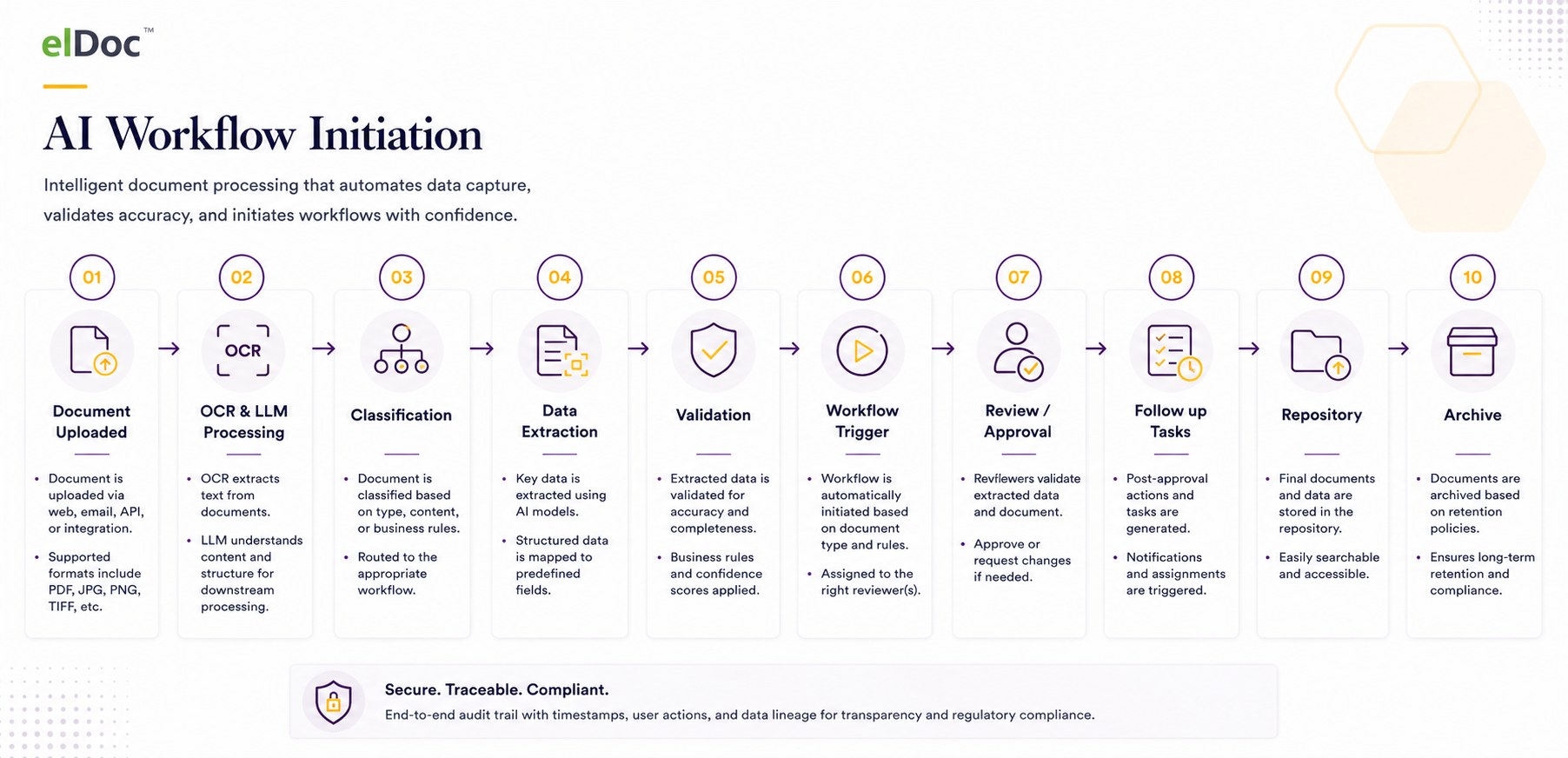
The architecture can support the complete document lifecycle:
| Stage | How elDoc Supports the Process |
|---|---|
| 01. Document Uploaded | Documents are received through web applications, email, APIs, integrations, or other enterprise channels. |
| 02. OCR & LLM Processing | OCR captures document text while AI and LLM capabilities understand its content, context, and structure. |
| 03. Classification | Documents are automatically identified by type, content, or predefined business rules and routed accordingly. |
| 04. Data Extraction | Required business information is captured and mapped into structured fields without traditional manual keying. |
| 05. Validation | Extracted information is checked for accuracy, completeness, confidence, and applicable business rules. |
| 06. Workflow Trigger | The appropriate workflow is automatically initiated according to document type, extracted information, and business logic. |
| 07. Review / Approval | Human reviewers can validate information, approve transactions, or request changes when human judgment is required. |
| 08. Follow-Up Tasks | Notifications, assignments, escalations, and subsequent business activities can be generated automatically. |
| 09. Repository | Documents and associated information are securely maintained and made searchable and accessible according to permissions. |
| 10. Archive | Documents can be retained and archived according to enterprise retention and compliance policies. |
One document can therefore move from ingestion to AI understanding, validation, workflow execution, approval, storage, and long-term retention within one controlled processing architecture.
Why This Matters at Hong Kong Enterprise Scale
Processing several hundred documents manually is an operational inconvenience.
Processing thousands or tens of thousands of documents every month across departments, entities, systems, and document types becomes an enterprise architecture challenge.
At this scale, organizations need to address much more than extraction accuracy.
They need to determine how documents enter the organization, how AI identifies them, which information should be captured, how data is validated, when exceptions require human intervention, which workflow should start, where the resulting information should be transferred, who has access to it, and how every processing action can be traced.
elDoc is designed to bring these capabilities together.
Instead of creating disconnected OCR, AI, workflow, document management, and integration environments, enterprises can establish a unified AI-powered document processing layer.
AI Document Processing Without Template-Heavy Configuration
Traditional document capture technologies frequently depend on templates, fixed document layouts, zones, and extensive configuration.
That approach becomes increasingly difficult when a large Hong Kong enterprise receives documents from hundreds or thousands of customers, suppliers, partners, or counterparties.
The layouts may all be different.
With elDoc, Generative AI and intelligent document processing can understand documents based on their content rather than depending exclusively on fixed templates.
This enables enterprises to process highly variable business documents while substantially reducing the configuration effort traditionally associated with document capture projects.
Depending on the business scenario, elDoc can be applied to documents such as:
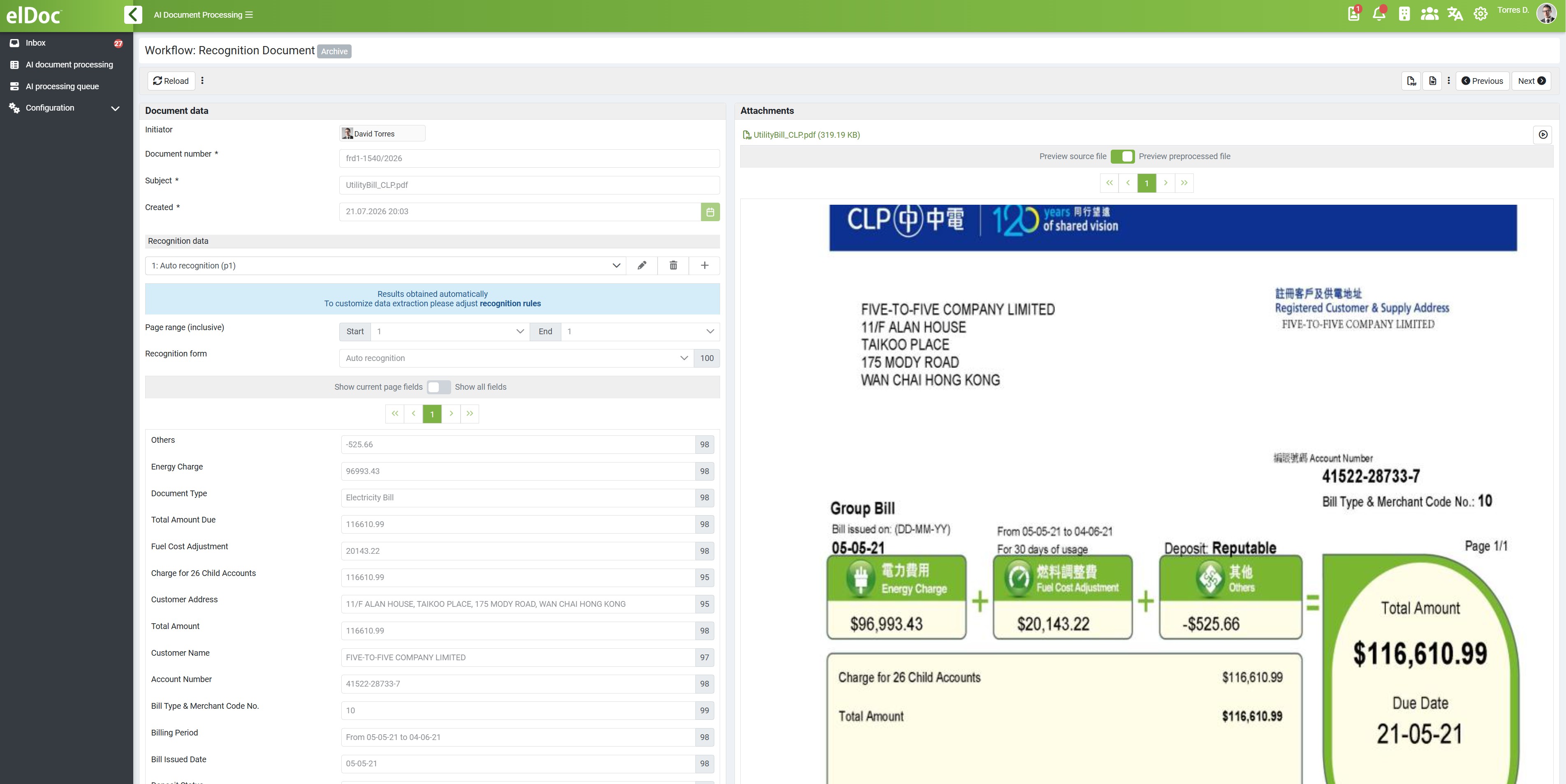
From AI Processing to Workflow Initiation
The workflow initiation stage is where document intelligence begins generating broader operational value.
Once elDoc understands what a document is and what information it contains, this information can determine what should happen next.
For example, an incoming document can automatically trigger a specific business process, be assigned to the appropriate department, initiate an approval, generate a follow-up task, create a notification, or transfer structured information to another enterprise application.
Business rules can also determine different processing paths.
A routine document may proceed through straight-through processing, while a high-value transaction, missing information, low-confidence extraction, or specific business condition can automatically initiate additional verification.
The objective is therefore not merely document processing automation.
It is document-driven business process automation.
Integration with Existing Enterprise Systems
Large Hong Kong organizations already operate complex technology environments.
An AI document processing platform cannot require enterprises to replace their ERP, CRM, finance, BPM, document management, or other core business systems.
elDoc is designed to operate as part of this architecture.
Through APIs and integrations, extracted and validated information can be transferred into downstream enterprise systems while documents and processing results can remain connected to the corresponding business transaction.
This enables organizations to build automated processing pipelines such as:
Document Received → AI Processing → Classification → Data Extraction → Validation → Approval → ERP/Business System → Repository → Archive
For high-volume environments, this can substantially reduce repetitive data entry and the operational effort required to move information manually between systems.
Secure, Traceable and Compliant Processing
For large enterprises, automation cannot come at the expense of governance.
Document processing frequently involves commercially sensitive, confidential, financial, customer, employee, or regulated information.
elDoc therefore provides an enterprise-controlled processing environment in which document activities can remain traceable throughout the workflow.
A complete audit trail can record relevant timestamps, processing events, user activities, workflow actions, and data lineage.
This becomes particularly important for Hong Kong enterprises operating in regulated industries or organizations that need to demonstrate how information has been processed and who has interacted with it.
Enterprise AI should not create a black box around document processing. It should make processing faster while preserving visibility, accountability, and control.
Talk to a Document Management Solutions Expert
Want to see how enterprise-scale AI document processing works in practice?
Talk to a Document Management Solutions expertand we will share real-world elDoc use cases demonstrating large-scale document processing, intelligent automation, and AI-powered workflows across organizations in Hong Kong, including government environments, the wider APAC region, and other countries.
Discover how elDoc can help your organization move from document processing to end-to-end intelligent automation at enterprise scale.